You will get Arabic RTL Localization for Web Apps | React, i18n, Logical CSS
Project details
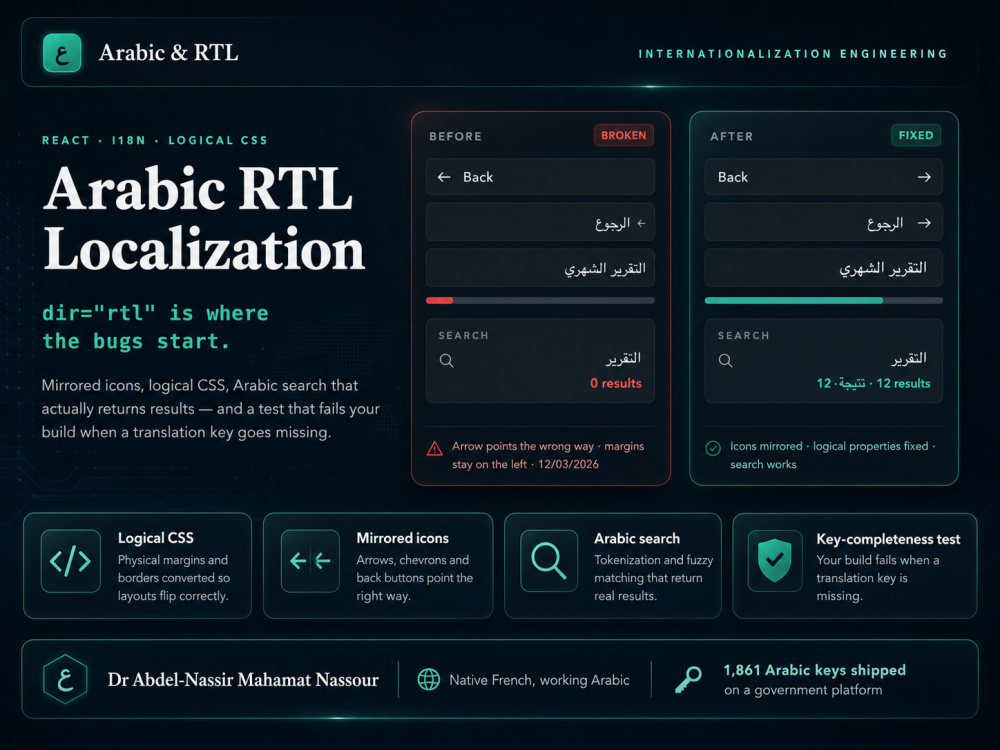
Most RTL work stops at dir="rtl". That is exactly where the bugs start.
WHAT ACTUALLY BREAKS: physical margins and borders (ml-, pr-, left:) that do not flip; directional icons — arrows, chevrons, back buttons — pointing the wrong way; dates and numbers still formatted in the source locale inside an Arabic interface; full-text search that returns nothing because the tokenizer was configured for English; hardcoded strings the extractor never saw; and layouts that look fine until an Arabic string is 40% longer than its French original.
WHAT I DO: convert physical CSS to logical properties, mirror directional icons, wire real locale formatting, fix Arabic tokenization and fuzzy search, extract remaining hardcoded strings, and add an automated test that fails the build when a translation key is missing.
WHY ME: I built the French/Arabic interface of a government platform for a national ministry (client under NDA) — 1,861 Arabic keys, 10 namespaces, full RTL, automated key-completeness testing. I speak Arabic and French. This is engineering, not a plugin install.
SCOPE: i18n engineering. For marketing copy I recommend a native reviewer — I will say so rather than pretend.
WHAT ACTUALLY BREAKS: physical margins and borders (ml-, pr-, left:) that do not flip; directional icons — arrows, chevrons, back buttons — pointing the wrong way; dates and numbers still formatted in the source locale inside an Arabic interface; full-text search that returns nothing because the tokenizer was configured for English; hardcoded strings the extractor never saw; and layouts that look fine until an Arabic string is 40% longer than its French original.
WHAT I DO: convert physical CSS to logical properties, mirror directional icons, wire real locale formatting, fix Arabic tokenization and fuzzy search, extract remaining hardcoded strings, and add an automated test that fails the build when a translation key is missing.
WHY ME: I built the French/Arabic interface of a government platform for a national ministry (client under NDA) — 1,861 Arabic keys, 10 namespaces, full RTL, automated key-completeness testing. I speak Arabic and French. This is engineering, not a plugin install.
SCOPE: i18n engineering. For marketing copy I recommend a native reviewer — I will say so rather than pretend.
Programming Languages
HTML & CSS, JavaScript, TypeScriptCoding Expertise
Cross Browser & Device Compatibility, Localization, DesignWhat's included
| Service Tiers |
Starter
$180
|
Standard
$490
|
Advanced
$950
|
|---|---|---|---|
| Delivery Time | 3 days | 7 days | 12 days |
Number of Revisions | 0 | 0 | 0 |
Design Customization | - | - | - |
Content Upload | - | - | - |
Responsive Design | - | - | - |
Source Code | - | - | - |
Frequently asked questions
About Mahamat Nassour
AI Engineer | RAG, LLM & Document AI | PhD, Ex-Cybersecurity Director
N'Djamena, Chad - 9:40 am local time
Most RAG systems hallucinate and almost nobody measures it. I do. On my own document-AI platform, on a golden dataset of real documents: groundedness 1.0, hallucination rate 0.0, appropriate refusal 1.0, deep-vision document quality 0.90 vs 0.44 for OCR alone. Real numbers with a reproducible method, not marketing claims.
WHAT I DO
- RAG systems and chatbots over your documents (PDF, Word, Excel, scans): hybrid search, reranking, grounded answers with page-level citations
- Audits of RAG/LLM apps that hallucinate: measured baseline, prioritized fix plan, regression tests you can re-run
- AI agents and LLM integrations (OpenAI, Claude, Ollama, OpenRouter) with cost tracking and no vendor lock-in
- Self-hosted and air-gapped AI where data cannot leave your infrastructure
- Security audits of AI applications: prompt injection, auth and role checks, exposed secrets
Stack: Python, FastAPI, Next.js, TypeScript, PostgreSQL 16 + pgvector, Ollama, OpenRouter, Docker, Keycloak, Redis, MinIO
I did not wrap a framework. I wrote the retrieval pipeline myself, which is why I can debug it when it fails.
WHAT I BUILT
SavoirBase AI, a complete self-hosted document intelligence platform I designed and built solo: 152 API operations, 21 screens, 391 tests. Full pipeline from ingestion and OCR through deep vision, adaptive chunking, bge-m3 embeddings, hybrid search (dense + full-text, RRF fusion), reranking, and strictly grounded generation that refuses to answer when no source supports it.
Also delivered: a sovereign state communication suite (Matrix, Keycloak, Hyperledger, K3s), a ministry-scale document management system, and a university ERP serving 2,450 students with handwritten OCR (I have worked on handwriting recognition since 2018).
BACKGROUND
- PhD in Computer Science, Universite de Reims Champagne-Ardenne, France
- Former Director General of a national cybersecurity and e-certification agency (3 years)
- Chaired the technical committee for the National Cybersecurity Strategy and for the Cybersecurity Maturity Model conducted with the University of Oxford
- 4 peer-reviewed publications (3 IEEE)
- MSc, INSEEC Paris
I build AI and I secure it, a combination very few people offer.
Languages: French (native), English (professional), Arabic
Tell me what your system is getting wrong, and I will tell you how I would measure it before touching anything.
START SMALL
You should not hand a four-figure project to someone with no reviews on this platform. I would not either. So start with a fixed-price audit: I build a golden dataset from your own documents, measure your system's real groundedness and hallucination rate, and hand you a prioritized fix plan with regression tests you can re-run yourself. Three days, fixed price, and you own everything I produce.
If the numbers come back good, you do not need me. If they do not, you will know exactly what is broken and what it costs to fix.
Steps for completing your project
After purchasing the project, send requirements so Mahamat Nassour can start the project.
Delivery time starts when Mahamat Nassour receives requirements from you.
Mahamat Nassour works on your project following the steps below.
Revisions may occur after the delivery date.
RTL audit and scope
I go through your app with the interface flipped and list exactly what breaks: physical CSS, mirrored icons, formats, tokenization, hardcoded strings. You get the list before any code is touched.
Logical CSS, mirroring, formats
Physical margins and borders converted to logical properties, directional icons mirrored, dates and numbers formatted per locale, and layouts checked against longer Arabic strings.