You will get An audit and recommendations to cut your LLM app's token cost
Rising Talent
Project details
I have experience with startup and enterprise AI deployments. You will immediately gain experience and knowledge in the following areas from someone who has gained it by real life trial and error.
Context engineering and prompt caching: deciding what goes into the model's window (system prompts, retrieved context, conversation state, token budgets) and caching aggressively so cost and latency stay low.
SSE streaming: streaming model output, tool-calls, and citations to the client token by token over Server-Sent Events, including making it traverse a CDN cleanly.
Durable and background workflows: job queues, scheduling, retries, idempotency, and resumable
long-running work , the plumbing AI features actually need.
AI SDK integration: hands-on with provider SDKs (tool-use and function calling, prompt caching,
streaming, vision, extended reasoning) and the judgment of when to use a provider SDK directly
versus a higher-level AI SDK.
RAG, memory, and retrieval: vector plus time-series retrieval that joins semantic similarity with structured filters.
Context engineering and prompt caching: deciding what goes into the model's window (system prompts, retrieved context, conversation state, token budgets) and caching aggressively so cost and latency stay low.
SSE streaming: streaming model output, tool-calls, and citations to the client token by token over Server-Sent Events, including making it traverse a CDN cleanly.
Durable and background workflows: job queues, scheduling, retries, idempotency, and resumable
long-running work , the plumbing AI features actually need.
AI SDK integration: hands-on with provider SDKs (tool-use and function calling, prompt caching,
streaming, vision, extended reasoning) and the judgment of when to use a provider SDK directly
versus a higher-level AI SDK.
RAG, memory, and retrieval: vector plus time-series retrieval that joins semantic similarity with structured filters.
AI Algorithms
Generative Adversarial Network, Large Language Model, Long Short-Term Memory Network, Multimodal Large Language Model, Recurrent Neural Network, Transformer ModelAI Applications
AI Mobile App Development, AI-Enhanced Classification, AI-Generated Code, AIOps, Conversational AI, Natural Language Generation, Natural Language Understanding, Sentiment Analysis, Synthetic Data Generation, Time Series Analysis, Time Series ForecastingAI Development Language
PythonAI Tools
Azure OpenAI, GitHub Copilot, Hugging Face, PyTorch, TensorFlowAI Models
GPT-4, LLaMA, Midjourney AI, Naive Bayes Classifier, WhisperWhat's included
| Service Tiers |
Starter
$350
|
Standard
$750
|
Advanced
$1,500
|
|---|---|---|---|
| Delivery Time | 4 days | 7 days | 14 days |
Number of Revisions | 1 | 2 | 1 |
AI Model Integration | - | - | - |
Batch Normalization | - | - | - |
Database Integration | - | - | - |
Detailed Code Comments | |||
Image Upscaling | - | - | - |
MLOps | - | - | |
Model Deployment | - | - | |
Model Documentation | |||
Model Monitoring | - | - | |
Model Testing & Optimization | |||
Model Tuning | - | ||
Natural Language Processing | - | - | - |
NLP Tokenization | - | - | - |
Pre-Training | - | - | - |
Prompt Engineering | - | ||
Setup File | - | - | - |
Source Code | - |
Frequently asked questions
About Wes
AI Architect & Engineer - Agents, RAG, MCP, Bedrock, Durable Workflows
Coldspring, United States - 6:13 am local time
What I help with:
Build AI into your product: AI agents and agentic workflows, RAG over your own data, context engineering and prompt caching, model routing and LLM gateways, MCP servers and integrations, AWS Bedrock and provider AI SDKs, memory (vector and graph), SSE streaming, durable background workflows (queues, scheduling, retries), guardrails, and evals and observability.
Set up AI-assisted development: agent harnesses, subagent pipelines, token and context optimization, autonomous workflows, and the patterns (and anti-patterns) that keep AI-assisted teams fast and consistent.
Architecture and advisory: get unstuck from prototype to production with eval strategy, cost and latency control, security and guardrails, and a clear maturity roadmap.
Selected work:
- Agentic AI health-coaching platform (HIPAA, AWS): a tool-using AI coach that reasons over a user's biomarker time-series, with model routing, SSE streaming, pgvector evidence retrieval, and full compliance infrastructure (KMS encryption, audit logging, row-level security) on ECS and CDK.
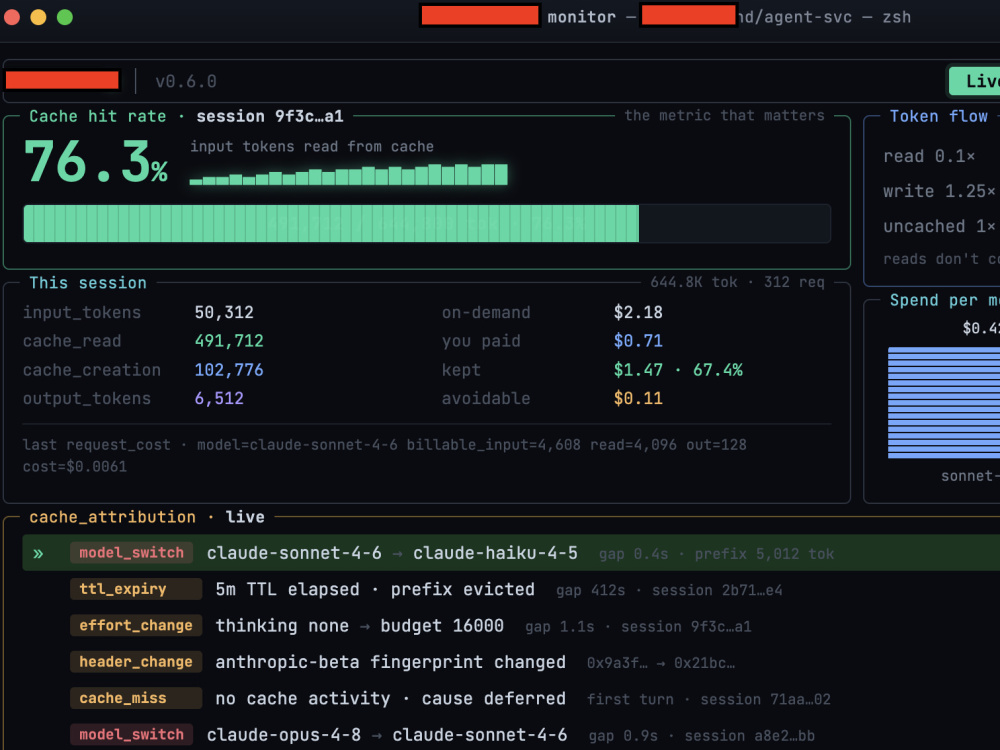
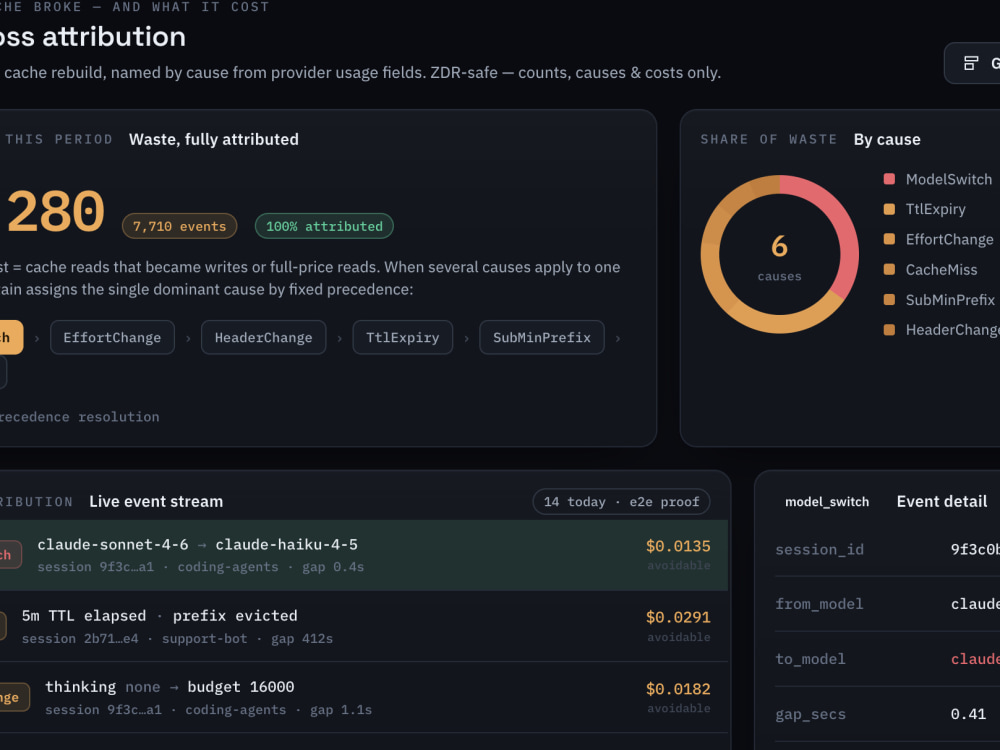
- LLM cost-optimization proxy (Rust): a byte-stable gateway in the request path that meters token spend and applies cache-safe optimizations without ever breaking the provider prompt cache, with per-request cache-loss attribution and model routing.
- Agentic dev harness (my own framework): a context-frugal PM / Architect / Engineer / QA pipeline with role subagents, on-demand skills, guard hooks (real end-to-end gates, no untraceable commits), and a strict context budget. Production-grade agent orchestration end to end.
- Also: an autonomous consumer-commerce agent (visual semantic search with CLIP and pgvector) and an explainable, risk-gated trading assistant (LLM news-sentiment plus rigorous walk-forward evaluation).
How I work:
- Real end-to-end verification over demos. I boot it and prove it works.
- Guardrails, evals, and observability from day one; cost and context treated as budgets.
- Tight scope, clear communication, production quality: typed APIs, no swallowed errors, no shortcuts that bite later.
Tech I use: Python, Rust, TypeScript, LLM APIs (Claude, OpenAI, Gemini), agentic tool-use, MCP (Model Context Protocol), RAG and vector search (pgvector, TimescaleDB), model routing and LLM gateways, AWS (Bedrock, ECS), and evals and observability.
If you are adding AI to a product, or leveling up how your team builds with AI, send a short note with what you are trying to ship and I will reply with the fastest credible path to production.
Steps for completing your project
After purchasing the project, send requirements so Wes can start the project.
Delivery time starts when Wes receives requirements from you.
Wes works on your project following the steps below.
Revisions may occur after the delivery date.
Client purchases the project and sends requirements
Provide high level overview of the project, expectations and timing. This should include how many people has touched the code, the maturity state it's in and if this will be a combined effort with someone else.
Project is accepted or rejected
Depending on expectations and state of the project it will be accepted or rejected and communicated to the client.