You will get Cattle Recognition Using Muzzle Print Biometrics
Project details
What sets me apart here is instead of treating cattle identification as a closed-set image classification task, I reframed it as a biometric recognition problem, similar to human fingerprint or face recognition, where scalability and reliability are critical.
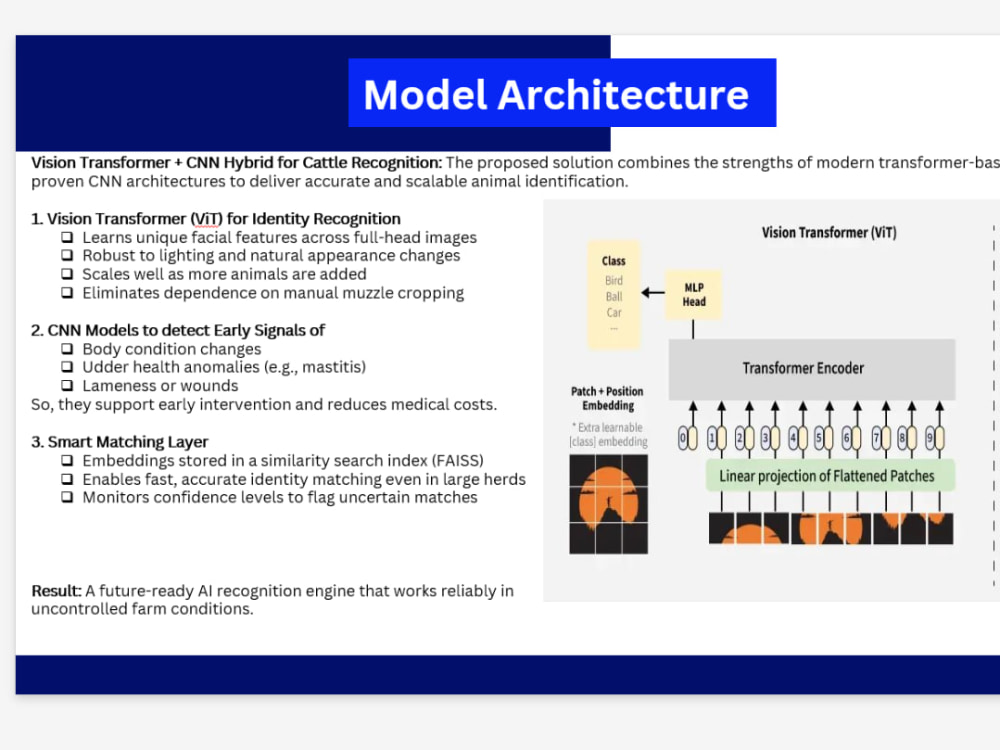
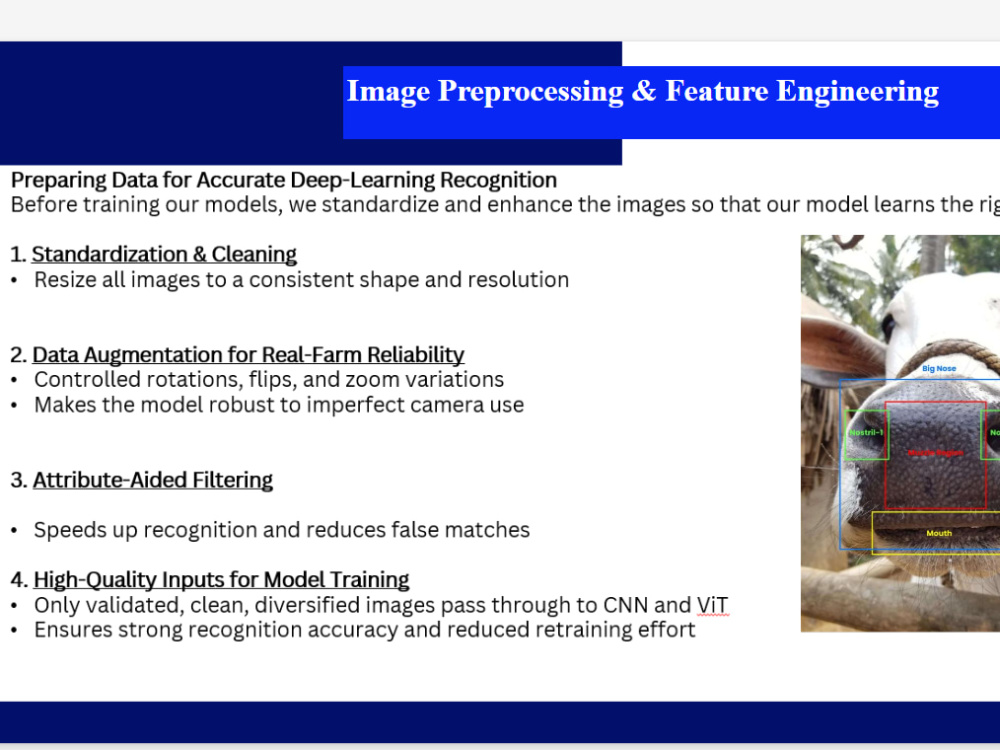
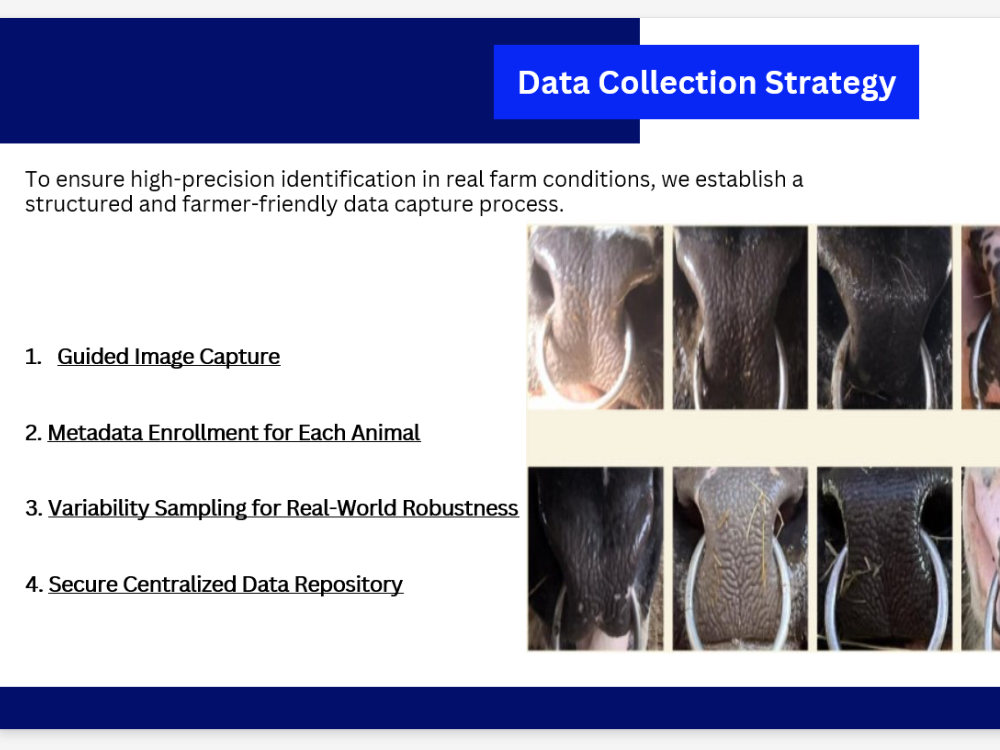
The project focuses on learning discriminative muzzle-print embeddings using deep learning. This allows the system to generalize beyond a fixed set of animals and supports adding new cattle without retraining the model, which is essential in real-world livestock environments. The approach is robust to variations in lighting, pose, and image quality, making it practical for on-field data capture using smartphones.
From a leadership perspective, I drove the architectural decisions, algorithm selection and evaluation strategy. My emphasis was on understanding the mathematical intuition behind the model behavior, defining meaningful evaluation metrics, and aligning technical decisions with business constraints such as fraud prevention and traceability.
The combination of deep technical reasoning, scalable system design, and a clear business lens is what differentiates both my contribution and the project outcome.
The project focuses on learning discriminative muzzle-print embeddings using deep learning. This allows the system to generalize beyond a fixed set of animals and supports adding new cattle without retraining the model, which is essential in real-world livestock environments. The approach is robust to variations in lighting, pose, and image quality, making it practical for on-field data capture using smartphones.
From a leadership perspective, I drove the architectural decisions, algorithm selection and evaluation strategy. My emphasis was on understanding the mathematical intuition behind the model behavior, defining meaningful evaluation metrics, and aligning technical decisions with business constraints such as fraud prevention and traceability.
The combination of deep technical reasoning, scalable system design, and a clear business lens is what differentiates both my contribution and the project outcome.
AI Development Type
Deep Learning, Model TuningAI Tools
MLflow, PyTorchAI Development Language
PythonWhat's included
| Service Tiers |
Starter
$200
|
Standard
$300
|
Advanced
$800
|
|---|---|---|---|
| Delivery Time | 15 days | 50 days | 70 days |
Number of Revisions | 4 | 8 | 14 |
AI Model Integration | - | - | |
Detailed Code Comments | - | - | |
Knowledge Graph | - | - | |
Model Documentation | - | - | |
Ontology | - | - | |
Source Code | - | - | |
Taxonomy | - | - |
Optional add-ons
You can add these on the next page.
Additional Revision
+$200About Gargi
Data Scientist
New Delhi, India - 2:58 am local time
PowerBI. I also use python and R for machine learning, data mining and other processes.
Steps for completing your project
After purchasing the project, send requirements so Gargi can start the project.
Delivery time starts when Gargi receives requirements from you.
Gargi works on your project following the steps below.
Revisions may occur after the delivery date.
Project Overview
I’ve built and deployed a computer vision model for biometric-style identification (facial recognition) as a POC, handling data preprocessing, model training, and evaluation. I can adapt this pipeline to your use case.
Approach & Architecture
Designed as a computer vision–based biometric system using deep feature embeddings and similarity learning instead of direct classification.