You will get End-to-End Machine Learning Pipeline for Business Analytics


Project details
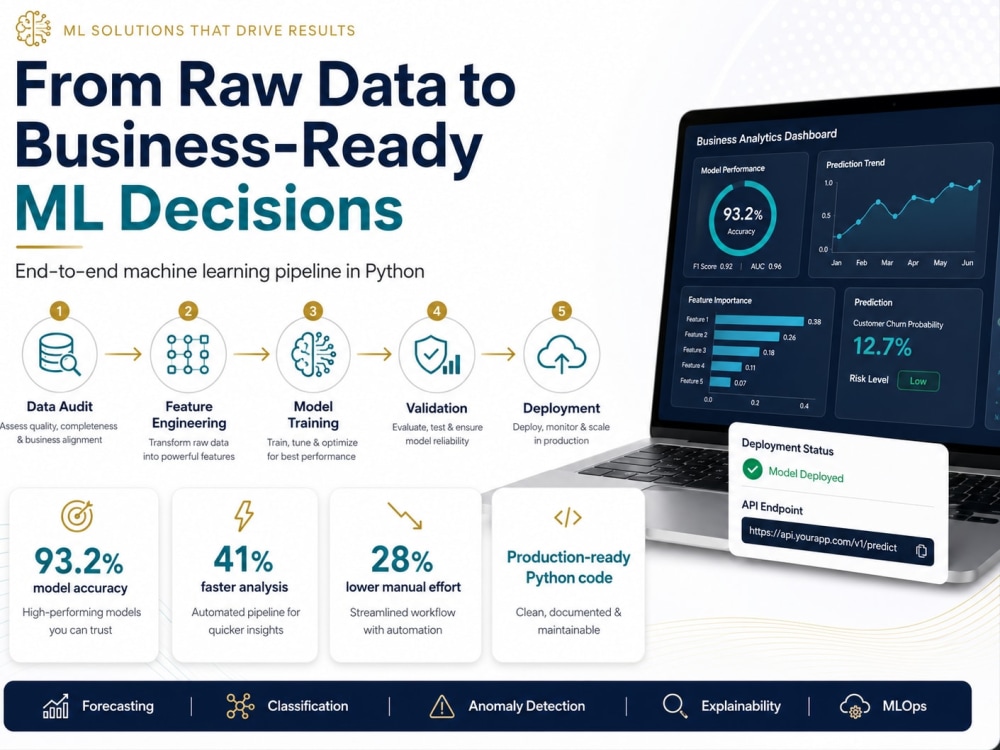
I provide end-to-end Machine Learning solutions using Python, designed to turn raw data into accurate, reliable, and explainable models. My approach goes beyond simply training algorithms. I focus on understanding the problem, engineering meaningful features, selecting the right models, and delivering results that are technically sound and practically useful.
Whether you need predictive modeling, classification, regression, deep learning, or algorithm optimization, I follow a structured and transparent workflow. This includes data auditing, preprocessing, feature engineering, model selection, hyperparameter tuning, and rigorous evaluation using appropriate metrics. Every solution is tailored to your dataset and objective, not copied from generic templates.
My work is suitable for research, production systems, startups, and decision-support applications where accuracy and reliability matter.
If you are looking for a professional who treats Machine Learning as an engineering discipline, not trial-and-error, this project is built for you.
Whether you need predictive modeling, classification, regression, deep learning, or algorithm optimization, I follow a structured and transparent workflow. This includes data auditing, preprocessing, feature engineering, model selection, hyperparameter tuning, and rigorous evaluation using appropriate metrics. Every solution is tailored to your dataset and objective, not copied from generic templates.
My work is suitable for research, production systems, startups, and decision-support applications where accuracy and reliability matter.
If you are looking for a professional who treats Machine Learning as an engineering discipline, not trial-and-error, this project is built for you.
Machine Learning Tools
deeplearn.js, NumPy, Python, Python Scikit-Learn, SciPy, XGBoostWhat's included
| Service Tiers |
Starter
$100
|
Standard
$200
|
Advanced
$1,000
|
|---|---|---|---|
| Delivery Time | 2 days | 3 days | 5 days |
Number of Revisions | Unlimited | Unlimited | Unlimited |
Model Validation/Testing | - | - | - |
Model Documentation | - | - | - |
Data Source Connectivity | - | - | - |
Source Code | - | - | - |
Frequently asked questions
6 reviews
(5)
(0)
(0)
(0)
(1)
This project doesn't have any reviews.
AM
Amila Hanifan M.
May 29, 2026
Using Machine Learning for Clinical Data Processing
It is with great pleasure and the highest level of professional regard that I write this official testimony for my esteemed partner, Dr. Umair Shahid. Dr. Shahid served as the Lead Machine Learning Architect on our critical research project focused on predicting infections in patients suffering from Systemic Lupus Erythematosus (SLE). Throughout the lifecycle of this initiative, his technical expertise, mathematical precision, and professional integrity were pivotal to our success.
In evaluating Dr. Shahid’s contributions, several key aspects of his performance stand out as exceptional:
1. Visionary Conceptualization and Pipeline Development: Dr. Shahid took full ownership of the end-to-end Machine Learning pipeline. Predicting infections in complex autoimmune conditions like SLE requires handling highly heterogeneous, noisy, and imbalanced clinical datasets. Dr. Shahid independently engineered a robust architectural pipeline from data preprocessing and feature extraction to predictive modeling. His structural approach ensured that the model seamlessly integrated clinical variables, establishing a highly scalable and reproducible framework that significantly pushed the boundaries of our clinical data utilization.
2. Methodological Rigor and SHAP Analysis: In the medical field, a predictive model cannot function as a "black box"; clinical explainability is critical. Dr. Shahid elegantly addressed this by implementing advanced statistical methods, specifically focusing on SHAP (SHapley Additive exPlanations) analysis. By embedding SHAP metrics into the core of our pipeline, he successfully deconstructed complex algorithmic outputs into transparent, clinician-friendly insights. This allowed us to quantify exactly how much each physiological marker contributed to an individual patient’s infection risk profile, bridging the gap between raw data science and bedside clinical practice.
3. Impeccable Work Ethics, Agility, and Competitive Pricing: Beyond his academic and technical brilliant capabilities, Dr. Shahid operates with an elite standard of professional ethics. He delivered highly sophisticated milestones on a remarkably accelerated timeline, demonstrating rare speed without ever compromising data reliability or structural integrity. Furthermore, he offered exceptionally competitive and transparent pricing, rendering enterprise-grade artificial intelligence development highly accessible and maximizing our project’s budgetary efficiency.
Dr. Umair Shahid possesses a rare combination of profound technical intellect, deep analytical capability, and a collaborative, client-centric ethos. His contributions have fundamentally elevated our diagnostic capability within the realm of SLE patient care.
I give Dr. Shahid my absolute highest recommendation for any complex algorithmic development, research leadership, or biomedical data engineering role. He will undoubtedly prove to be a transformative asset to any organization or advanced clinical initiative fortunate enough to secure his expertise.
In evaluating Dr. Shahid’s contributions, several key aspects of his performance stand out as exceptional:
1. Visionary Conceptualization and Pipeline Development: Dr. Shahid took full ownership of the end-to-end Machine Learning pipeline. Predicting infections in complex autoimmune conditions like SLE requires handling highly heterogeneous, noisy, and imbalanced clinical datasets. Dr. Shahid independently engineered a robust architectural pipeline from data preprocessing and feature extraction to predictive modeling. His structural approach ensured that the model seamlessly integrated clinical variables, establishing a highly scalable and reproducible framework that significantly pushed the boundaries of our clinical data utilization.
2. Methodological Rigor and SHAP Analysis: In the medical field, a predictive model cannot function as a "black box"; clinical explainability is critical. Dr. Shahid elegantly addressed this by implementing advanced statistical methods, specifically focusing on SHAP (SHapley Additive exPlanations) analysis. By embedding SHAP metrics into the core of our pipeline, he successfully deconstructed complex algorithmic outputs into transparent, clinician-friendly insights. This allowed us to quantify exactly how much each physiological marker contributed to an individual patient’s infection risk profile, bridging the gap between raw data science and bedside clinical practice.
3. Impeccable Work Ethics, Agility, and Competitive Pricing: Beyond his academic and technical brilliant capabilities, Dr. Shahid operates with an elite standard of professional ethics. He delivered highly sophisticated milestones on a remarkably accelerated timeline, demonstrating rare speed without ever compromising data reliability or structural integrity. Furthermore, he offered exceptionally competitive and transparent pricing, rendering enterprise-grade artificial intelligence development highly accessible and maximizing our project’s budgetary efficiency.
Dr. Umair Shahid possesses a rare combination of profound technical intellect, deep analytical capability, and a collaborative, client-centric ethos. His contributions have fundamentally elevated our diagnostic capability within the realm of SLE patient care.
I give Dr. Shahid my absolute highest recommendation for any complex algorithmic development, research leadership, or biomedical data engineering role. He will undoubtedly prove to be a transformative asset to any organization or advanced clinical initiative fortunate enough to secure his expertise.
TT
Tama Medika Inovasi T.
Mar 9, 2026
Building MODEL 3 of CTD-ILD severity Research
I would like to express my sincere appreciation for the outstanding contributions of Dr. Umair Shahid, PhD, in our collaborative research project focused on predicting disease severity using clinical parameters and high-resolution CT (HRCT) data.
Dr. Shahid demonstrated exceptional diligence and professionalism throughout the project. His strong work ethic and commitment to scientific rigor ensured that every stage of the data analysis process was conducted carefully and systematically.
One of his most valuable contributions was his innovative idea to employ multiple machine learning approaches in the modeling process. By integrating several algorithms and comparing their predictive performance, he helped strengthen the robustness and credibility of our analytical framework. This approach significantly improved the reliability of the disease severity prediction models.
In addition, Dr. Shahid showed remarkable skill in developing clear and informative graphical illustrations, which greatly enhanced the interpretability of the results for both technical and non-technical audiences. His ability to translate complex analytical outputs into well-structured visual representations made our findings much easier to communicate during presentations and discussions.
Furthermore, Dr. Shahid’s excellent mathematical and analytical insight played a crucial role in optimizing the modeling process. His understanding of statistical principles and machine learning methodologies allowed the project to maintain a high level of methodological rigor.
Overall, Dr. Shahid is a highly competent researcher with strong analytical skills, creativity, and dedication. His contributions were instrumental to the success of this project, and I look forward to future collaborations with him.
Dr. Shahid demonstrated exceptional diligence and professionalism throughout the project. His strong work ethic and commitment to scientific rigor ensured that every stage of the data analysis process was conducted carefully and systematically.
One of his most valuable contributions was his innovative idea to employ multiple machine learning approaches in the modeling process. By integrating several algorithms and comparing their predictive performance, he helped strengthen the robustness and credibility of our analytical framework. This approach significantly improved the reliability of the disease severity prediction models.
In addition, Dr. Shahid showed remarkable skill in developing clear and informative graphical illustrations, which greatly enhanced the interpretability of the results for both technical and non-technical audiences. His ability to translate complex analytical outputs into well-structured visual representations made our findings much easier to communicate during presentations and discussions.
Furthermore, Dr. Shahid’s excellent mathematical and analytical insight played a crucial role in optimizing the modeling process. His understanding of statistical principles and machine learning methodologies allowed the project to maintain a high level of methodological rigor.
Overall, Dr. Shahid is a highly competent researcher with strong analytical skills, creativity, and dedication. His contributions were instrumental to the success of this project, and I look forward to future collaborations with him.
TT
Tama Medika Inovasi T.
Mar 1, 2026
Using MONAI framework to Determine CTD-ILD severity
I would like to express my sincere appreciation for the outstanding contribution of Umair Shahid, PhD, in our CTD-ILD severity project utilizing the MONAI Platform. Throughout the project, Dr. Shahid consistently demonstrated exceptional work ethic, professionalism, and strong research ethics. His dedication, reliability, and attention to detail were evident in every phase of the work.
Dr. Shahid introduced innovative and practical ideas to improve the efficiency of HRCT data analysis, including optimized preprocessing pipelines, streamlined segmentation workflows, and reproducible analytical strategies. These contributions significantly reduced computational time while preserving analytical accuracy and clinical relevance.
Importantly, he also proposed and implemented the integration of multiple AI platforms and frameworks alongside MONAI to enhance data processing, model development, and validation. This multi-platform approach strengthened the robustness, flexibility, and scalability of our research pipeline.
His technical insight, interdisciplinary mindset, and commitment to high-quality research were instrumental to the success of this project. I strongly recommend Dr. Umair Shahid for advanced medical AI and imaging research initiatives.
Dr. Shahid introduced innovative and practical ideas to improve the efficiency of HRCT data analysis, including optimized preprocessing pipelines, streamlined segmentation workflows, and reproducible analytical strategies. These contributions significantly reduced computational time while preserving analytical accuracy and clinical relevance.
Importantly, he also proposed and implemented the integration of multiple AI platforms and frameworks alongside MONAI to enhance data processing, model development, and validation. This multi-platform approach strengthened the robustness, flexibility, and scalability of our research pipeline.
His technical insight, interdisciplinary mindset, and commitment to high-quality research were instrumental to the success of this project. I strongly recommend Dr. Umair Shahid for advanced medical AI and imaging research initiatives.
MR
Muhammad Umair R.
Feb 25, 2026
Inventory Optimization Using Mathematical Modeling (IBM CPLEX Required)
Highly recommened for any Optimization and Mathematical based problem solving. He delivers a stunning tool which is extremely critical for an Industrial based setup for the future industries. Thank you and will work with you in the near future.
LF
Layla F.
Dec 22, 2025
CPLEX/OPL Expert Needed for MILP Model Implementation
Umair understood my complex optimization requirements perfectly from the start. He delivered a fully functional CPLEX model ahead of schedule, with clear documentation and validation.
Communication was excellent, and his proactive approach made the project smooth and successful.
I highly recommend him for MILP and optimization projects and will work with him again.
Communication was excellent, and his proactive approach made the project smooth and successful.
I highly recommend him for MILP and optimization projects and will work with him again.
About Umair
Computational Optimization | Machine Learning | Business Analytics
100%
Job Success
Taxila, Pakistan - 9:07 am local time
I specialize in Python-based analytical systems, that do not only analyze data but also support real operational decisions. I combine Operations Research, Machine Learning, Forecasting, Simulation, and Python-based analytics to solve problems related to scheduling, resource allocation, prediction, classification, capacity planning, business intelligence, and system optimization.
What I Can Help You With
Computational Optimization & Mathematical Modeling
I formulate and solve real-world decision problems using linear programming, mixed-integer linear programming, scheduling models, resource allocation models, routing models, and constraint-based optimization. I work with Python, Pyomo, CPLEX logic, CBC solver, MATLAB, GAMS, and Excel-based optimization tools.
Healthcare Optimization & Decision Support
I have strong experience in healthcare operations research, including operating room scheduling, patient-flow optimization, hospital resource planning, PACU/ICU capacity analysis, staff allocation, and AI-driven healthcare decision-support frameworks. My focus is on improving utilization, reducing delays, and supporting evidence-based operational decisions.
Machine Learning & Predictive Analytics
I develop supervised machine learning models for regression, classification, forecasting, risk prediction, and performance analysis. My experience includes Random Forest, XGBoost, CatBoost, SVM, Decision Trees, feature engineering, model validation, and performance evaluation using MAE, RMSE, R², accuracy, AUC, F1-score, and other KPIs.
Computer Vision & Image-Based AI
I work on image preprocessing, feature extraction, computer vision regression/classification, medical image analytics, segmentation-based analysis, and AI-assisted visual decision systems. I can support projects involving OpenCV, Python, image datasets, clinical imaging features, and machine learning-based image interpretation.
Forecasting & Business Analytics
I help businesses and researchers build forecasting models, demand prediction systems, KPI dashboards, market analytics, operational performance reports, and decision-ready business insights. I can analyze structured data and translate results into clear recommendations for management, research, or client-facing reports.
Research, Reports & Technical Documentation
Along with modeling and analytics, I prepare professional technical reports, research manuscripts, white papers, methodology sections, literature reviews, results interpretation, and publication-style documentation. I can turn raw datasets, models, and technical concepts into clear, polished, and client-ready deliverables.
Tools & Technologies
Python | Pyomo | Scikit-learn | Pandas | NumPy | Matplotlib | OpenCV | MATLAB | Simulink | CPLEX | CBC Solver | GAMS | Excel Solver | Machine Learning | Optimization | Forecasting | Predictive Modeling | Computer Vision | Business Analytics | Decision Support Systems
Industries I Work With
Healthcare Systems
Business Operations
Supply Chain and Logistics
Manufacturing and Production Systems
Research and Academic Projects
AI/ML-Based Decision Systems
Engineering and Technical Consulting
My goal is simple: to help you solve complex problems with clear models, reliable data analysis, and practical decision-support outputs. Whether you need an optimization model, a machine learning pipeline, a forecasting system, a computer vision workflow, or a complete analytical report, I can help you build a solution that is technically sound, well-documented, and ready for real-world use.
Let’s connect and turn your operational chaos into confident, data-driven decisions using the power of analytics, optimization, and intelligent AI systems.
Steps for completing your project
After purchasing the project, send requirements so Umair can start the project.
Delivery time starts when Umair receives requirements from you.
Umair works on your project following the steps below.
Revisions may occur after the delivery date.
Problem Understanding & Data Audit
Understand objectives, inspect data quality, identify features, target leakage, and feasibility of ML approaches.