You will get faster SQL queries and a database schema that actually scales
Project details
Slow queries are rarely a mystery. They are usually a query plan nobody has looked at, an index that does not match how the data is actually read, or a schema that made sense at a thousand rows and stopped making sense at ten million.
I hold an Oxford DPhil in AI and have spent over 15 years building data systems on PostgreSQL, SQL Server, MySQL and SQLite for large organisations.
How I work:
• I read the execution plans before changing anything, so fixes are evidence-based
• I add only the indexes that earn their keep, because every index costs you on writes
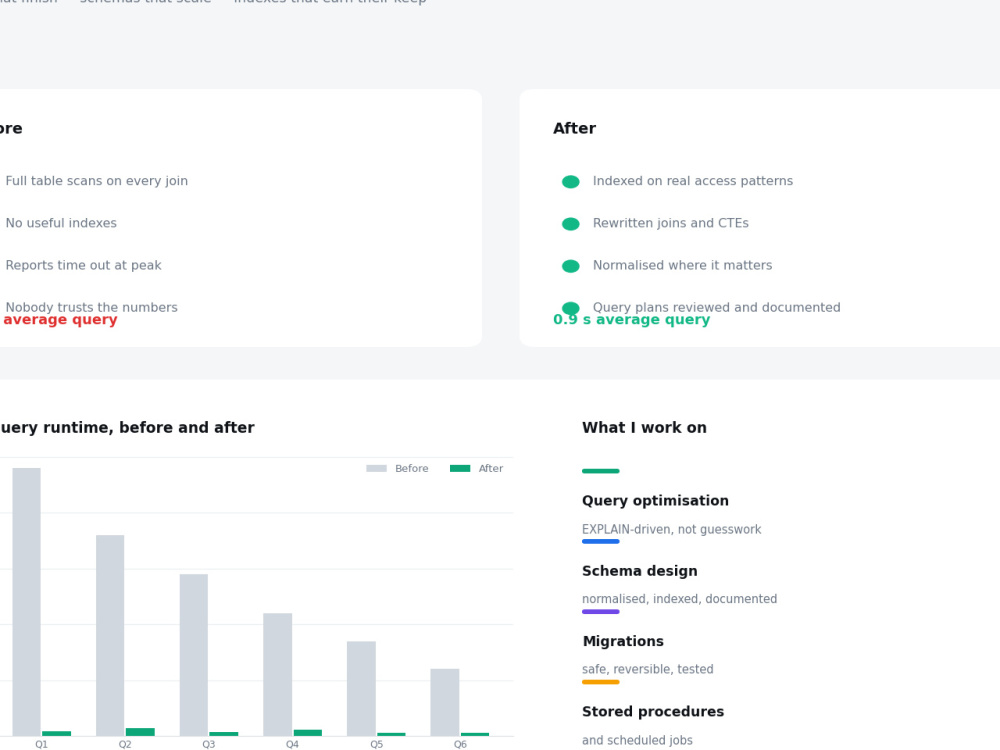
• I time everything before and after, on your real data volumes
• I document what changed and why, so your team is not left with mystery SQL
What you get: rewritten queries with before-and-after timings, an indexing strategy, and on the top tier a reviewed schema with tested, reversible migration scripts.
If your real problem turns out to be hardware, connection pooling or the application layer rather than the SQL, I will say so rather than bill you for optimising the wrong thing.
I hold an Oxford DPhil in AI and have spent over 15 years building data systems on PostgreSQL, SQL Server, MySQL and SQLite for large organisations.
How I work:
• I read the execution plans before changing anything, so fixes are evidence-based
• I add only the indexes that earn their keep, because every index costs you on writes
• I time everything before and after, on your real data volumes
• I document what changed and why, so your team is not left with mystery SQL
What you get: rewritten queries with before-and-after timings, an indexing strategy, and on the top tier a reviewed schema with tested, reversible migration scripts.
If your real problem turns out to be hardware, connection pooling or the application layer rather than the SQL, I will say so rather than bill you for optimising the wrong thing.
Database Type
MySQL, MS SQL, SQLite, PostgreSQLWhat's included
| Service Tiers |
Starter
$180
|
Standard
$480
|
Advanced
$1,200
|
|---|---|---|---|
| Delivery Time | 3 days | 7 days | 14 days |
Number of Revisions | 1 | 2 | 3 |
Number of Queries | 5 | 15 | 40 |
Query Debugging | |||
Query Optimization | |||
Query Scheduling | - | - | - |
Query Analysis | - | ||
Source Code | - | - |
About Jude
Machine Learning Expert | Data Visualization & Automation | Oxford PhD
London, United Kingdom - 3:57 pm local time
Steps for completing your project
After purchasing the project, send requirements so Jude can start the project.
Delivery time starts when Jude receives requirements from you.
Jude works on your project following the steps below.
Revisions may occur after the delivery date.
Measure first, with query plans
I profile the queries and read the execution plans, so changes are based on what the database is actually doing rather than on guesswork about indexes.
Rewrite, index and test
I rewrite the queries, add only the indexes that earn their keep, and on the top tier reshape the schema. Every change is timed before and after on your real data volumes.