You will get my AI editorial system tailored for repeatable editorial tasks
Project details
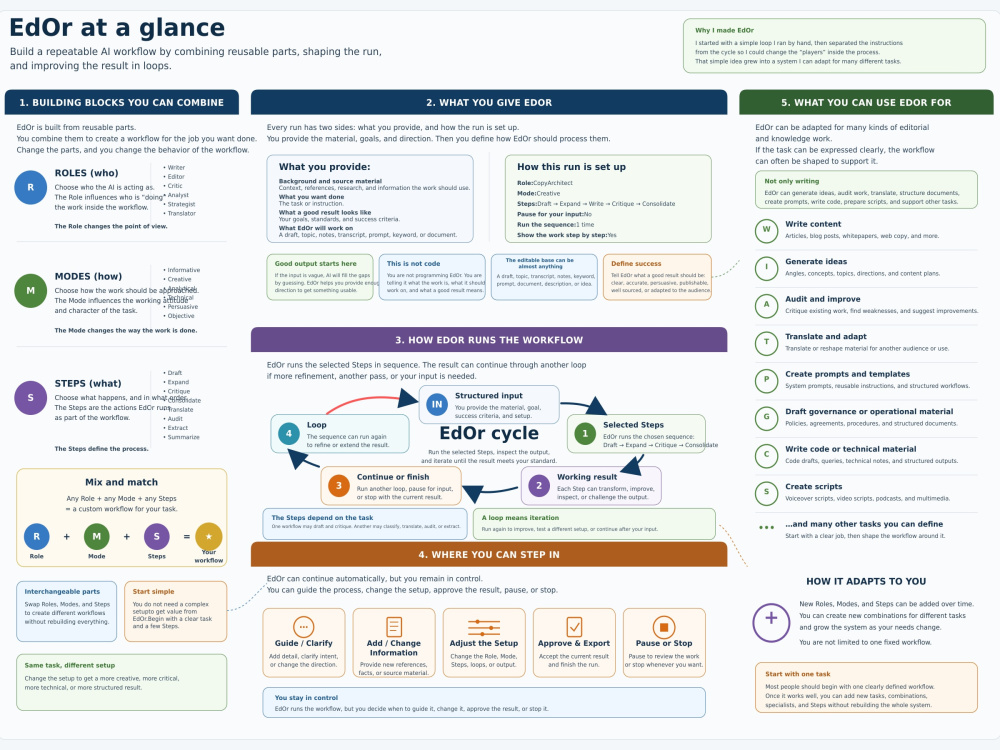
EdOr, The Editorial Orchestrator, is a Composable AI-based Editorial Workbench with over 30 combinable and loopable operations.
I started developing EdOr a few years ago to optimize my repetitive and complex editorial tasks. Since then, EdOr has evolved into an incredibly powerful and versatile editorial workbench with more than 30 composable actions - Roles, Modes and Steps (specialists), that can be combined in endless ways.
Together we can build some rad workflows for you: write system prompts of any kind; turn an idea, keywords or a rough draft into finished content; oppose your own statements to reveal weak assumptions and counterarguments; inspect, audit, translate, code, expand, distill, consolidate or orthogonalize material; or anisotropically expand a concept to reveal hidden structures, new dimensions and perspectives.
For this project, I write an original EdOr stack composed of a Role (i.e. Writer), a Mode (i.e. Creative) and 3 Steps (i.e. Write, Critique, Consolidate) around a real task from your work.
You receive the configured system, templates, setup files, a usage guide and the source code. EdOr is open source and freely available.
I started developing EdOr a few years ago to optimize my repetitive and complex editorial tasks. Since then, EdOr has evolved into an incredibly powerful and versatile editorial workbench with more than 30 composable actions - Roles, Modes and Steps (specialists), that can be combined in endless ways.
Together we can build some rad workflows for you: write system prompts of any kind; turn an idea, keywords or a rough draft into finished content; oppose your own statements to reveal weak assumptions and counterarguments; inspect, audit, translate, code, expand, distill, consolidate or orthogonalize material; or anisotropically expand a concept to reveal hidden structures, new dimensions and perspectives.
For this project, I write an original EdOr stack composed of a Role (i.e. Writer), a Mode (i.e. Creative) and 3 Steps (i.e. Write, Critique, Consolidate) around a real task from your work.
You receive the configured system, templates, setup files, a usage guide and the source code. EdOr is open source and freely available.
AI Algorithms
Large Language Model, Transformer ModelAI Applications
AI Content Creation, Natural Language Generation, Natural Language UnderstandingAI Tools
Azure OpenAI, Hugging FaceAI Models
ChatGPT, GPT-3, GPT-4, LLaMAWhat's included
| Service Tiers |
Starter
$600
|
Standard
$1,200
|
Advanced
$3,900
|
|---|---|---|---|
| Delivery Time | 5 days | 7 days | 14 days |
Number of Revisions | 2 | 3 | 4 |
AI Model Integration | |||
Batch Normalization | - | - | - |
Database Integration | - | - | - |
Detailed Code Comments | - | - | - |
Image Upscaling | - | - | - |
MLOps | - | - | - |
Model Deployment | - | - | - |
Model Documentation | - | - | |
Model Monitoring | - | - | - |
Model Testing & Optimization | |||
Model Tuning | - | - | - |
Natural Language Processing | - | - | - |
NLP Tokenization | - | - | - |
Pre-Training | - | - | - |
Prompt Engineering | |||
Setup File | |||
Source Code |
Frequently asked questions
About Pablo
AI Governance & Workflow Architect | LLM/RAG | Team Enablement
Kings County, United States - 9:31 pm local time
In a focused engagement, I map the actual workflow, identify failure points and weak handoffs, define the necessary guardrails and human-review conditions, and produce an implementation-ready action plan. I can also help implement the resulting workflow using LLMs, RAG, automation tools, APIs, structured prompts, and lightweight operational documentation.
My work is especially useful when:
* An AI workflow works in demonstrations but fails under real operating conditions.
* A team is using ChatGPT, Claude, agents, or RAG without clear governance or evaluation.
* An organization needs to decide what should be automated and what must remain human-controlled.
* A CRM, sales, research, editorial, or knowledge workflow needs AI integration.
* Leadership needs someone who can translate between business needs, technical implementation, and human operations.
I bring more than 25 years of experience across technology infrastructure, automation, entrepreneurship, sales systems, executive communication, and decision-support workflows. I work fluently in English, Spanish, and Italian.
Steps for completing your project
After purchasing the project, send requirements so Pablo can start the project.
Delivery time starts when Pablo receives requirements from you.
Pablo works on your project following the steps below.
Revisions may occur after the delivery date.
I review your task, materials and goals
I study the process you want to improve, what you will give EdOr to work on, who the result is for, and what you want the result to achieve.
We define the scope
We meet on Zoom to identify the best "stack" with Role, Mode, Steps, loops, user pauses and output format.