You will get OpenAI/Claude API integrated into your Python app
Project details
Most LLM integrations are prompt wrappers with no error handling, no structure, and no thought behind them. That works in demos. It breaks in production.
My background is computational physics at Arizona State University. I approach LLM integration the way a scientist does - I care about why the system behaves the way it does, not just whether it runs once.
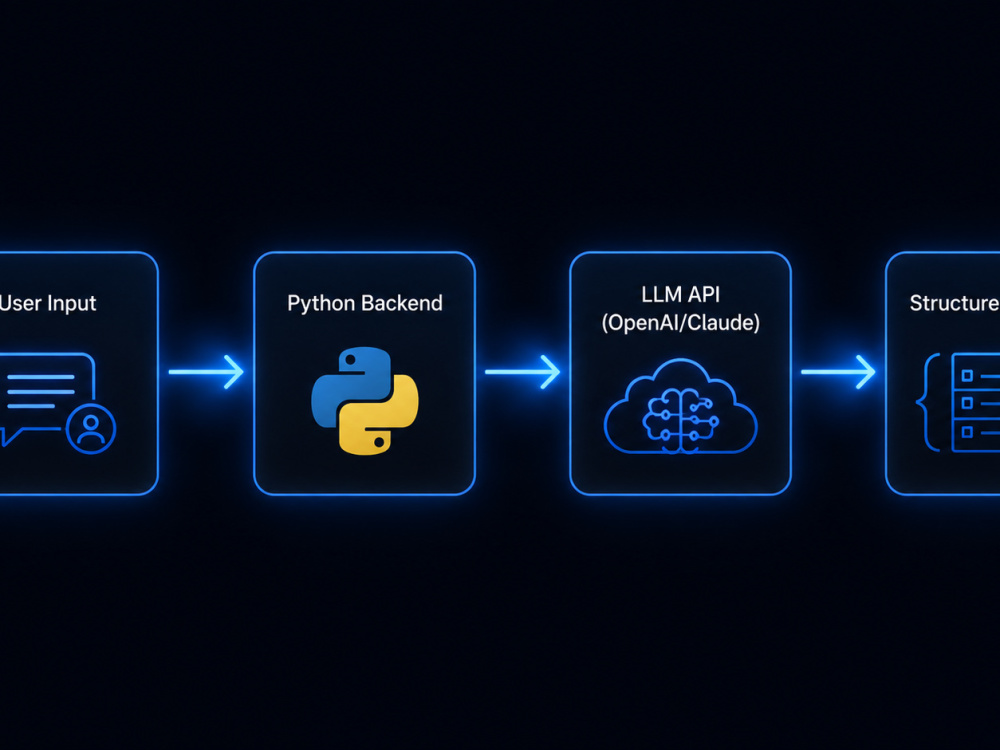
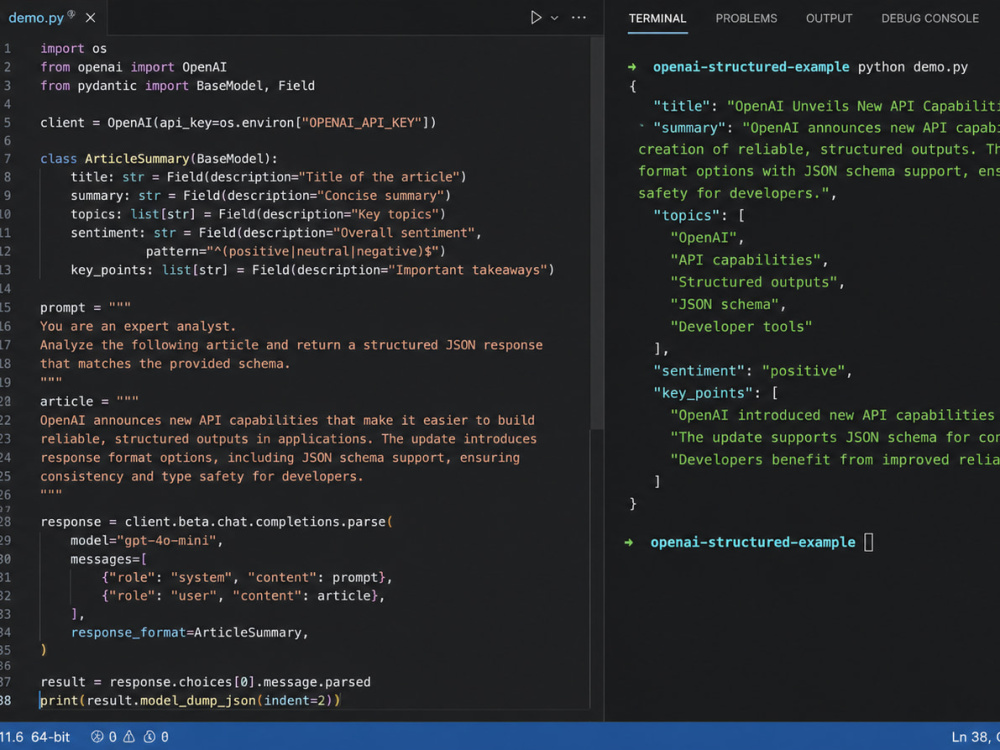
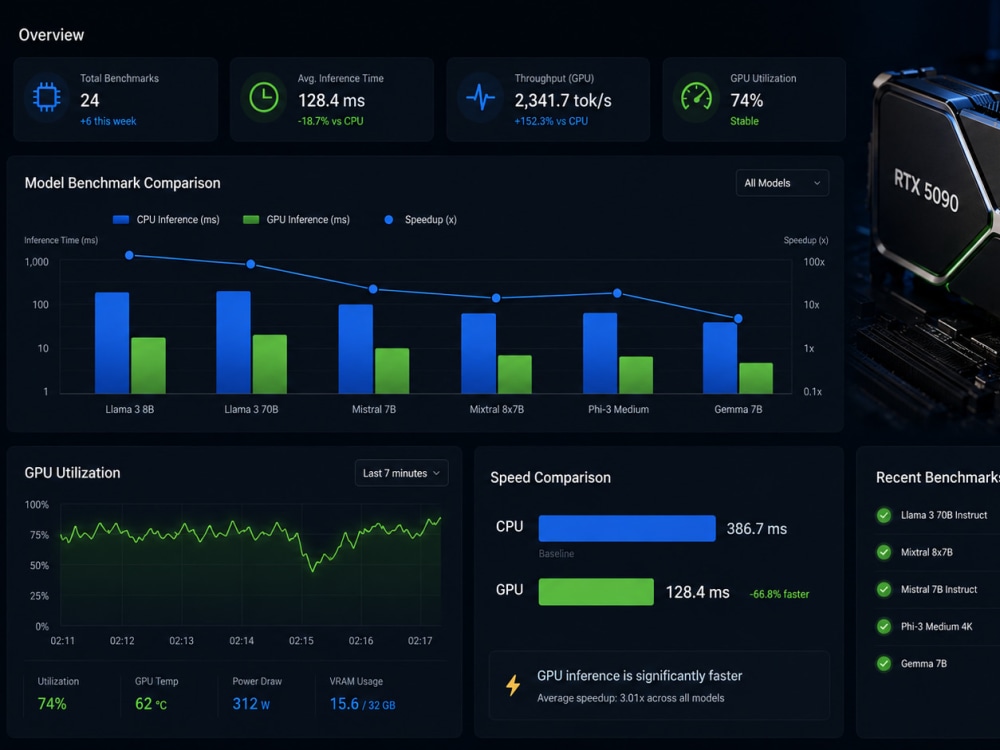
What that means for you: clean API integration with proper error handling, rate limiting, structured outputs via Pydantic, and code you can actually maintain after I'm done. I work locally on an RTX 5090, so no cloud queue delays on GPU workloads.
I've built pipelines over scientific and numerical data, RAG systems for document retrieval, and LLM integrations wired into real business workflows - not toy examples.
If your project needs to work reliably under real conditions, not just pass a demo - this is the tier you want.
My background is computational physics at Arizona State University. I approach LLM integration the way a scientist does - I care about why the system behaves the way it does, not just whether it runs once.
What that means for you: clean API integration with proper error handling, rate limiting, structured outputs via Pydantic, and code you can actually maintain after I'm done. I work locally on an RTX 5090, so no cloud queue delays on GPU workloads.
I've built pipelines over scientific and numerical data, RAG systems for document retrieval, and LLM integrations wired into real business workflows - not toy examples.
If your project needs to work reliably under real conditions, not just pass a demo - this is the tier you want.
AI Development Type
Deep Learning, Knowledge Representation, Model Tuning, Software MaintenanceAI Tools
Keras, MLflow, OpenCV, PyTorchAI Development Language
PythonWhat's included
| Service Tiers |
Starter
$150
|
Standard
$350
|
Advanced
$600
|
|---|---|---|---|
| Delivery Time | 3 days | 5 days | 7 days |
Number of Revisions | 1 | 2 | 3 |
AI Model Integration | |||
Detailed Code Comments | |||
Knowledge Graph | - | - | |
Model Documentation | - | ||
Ontology | - | - | - |
Source Code | |||
Taxonomy | - | - | - |
Optional add-ons
You can add these on the next page.
Deployment to cloud (AWS/GCP)
(+ 2 Days)
+$100Frequently asked questions
About Batyr
AI Integration Engineer | Computational Physics Researcher | LLM APIs
Ashgabat, Turkmenistan - 3:42 pm local time
I'm currently an undergraduate researcher in computational physics, working toward a PhD. My day-to-day involves hard numerical methods and high-dimensional math - LLM API integration is, by comparison, a straightforward engineering problem. That gap in difficulty is what you're hiring.
My background is computational physics (Arizona State University) - which means I approach ML and LLM integration the way a scientist does: I care about correctness, performance, and reproducibility, not just getting a demo to run.
What I deliver:
→ LLM API integrations (OpenAI, Anthropic, Mistral) wired into real business workflows
→ AI pipelines over scientific/numerical data using PyTorch, NumPy, SciPy
→ Physics-Informed Neural Networks (PINNs) for simulation acceleration
→ GPU-accelerated ML workloads (local RTX 5090 — no cloud wait times)
→ RAG systems, embedding pipelines, and structured data extraction
My physics training gives me something most AI freelancers lack: I can reason about why a model is failing, not just tune hyperparameters until it stops.
If you have a dataset, a simulation, or a workflow that needs ML or LLM integration done properly - let's talk.
Steps for completing your project
After purchasing the project, send requirements so Batyr can start the project.
Delivery time starts when Batyr receives requirements from you.
Batyr works on your project following the steps below.
Revisions may occur after the delivery date.
Requirements Review
I review your codebase and clarify the integration scope before writing a single line.
Integration
Build I wire in the LLM API with proper error handling, rate limiting, and structured outputs.