You will get Python HTML Parser for Regulatory Documents
Project details
Sixteen years working with statute documents, compliance filings, and regulatory data in insurance gave me something most Python developers don't have: I know what legal and regulatory HTML actually contains, how it's structured, and where the edge cases are.
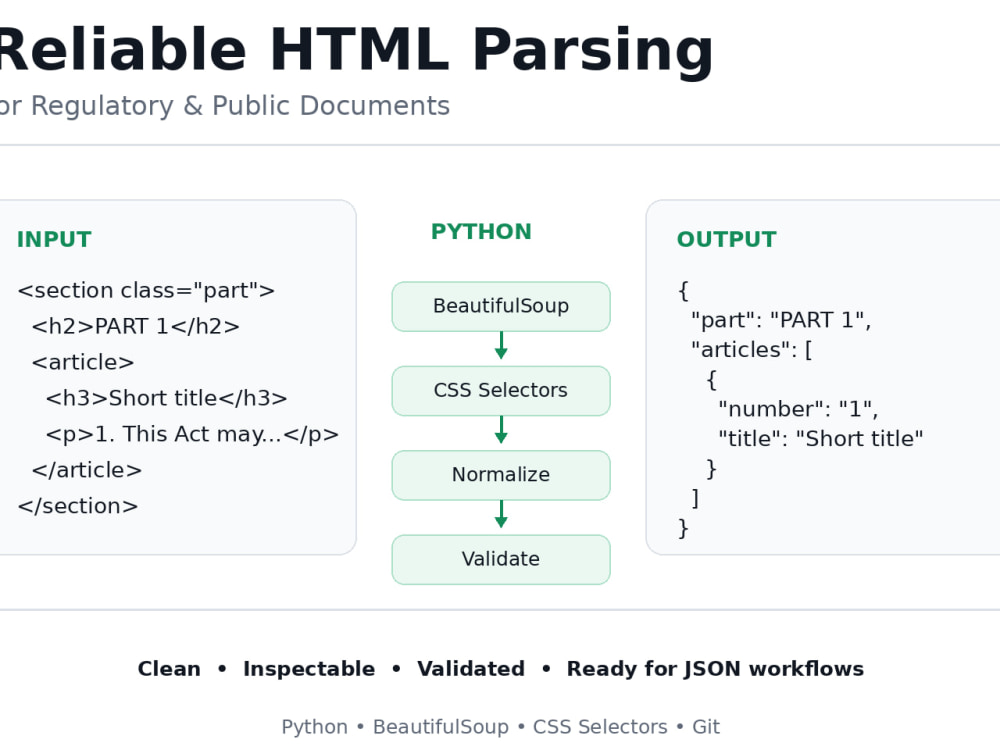
This project delivers a Python parser for one HTML source — statute pages, compliance databases, regulatory filings, or legal document repositories — that extracts the specific fields you need and outputs clean JSON or CSV.
What you get: a readable Python script using BeautifulSoup and CSS selectors, validation against your schema, a README with run instructions, and test cases on the extracted data. No heavy dependencies. Delivered so you can read, run, and modify the code yourself.
Best fit: regulatory documents, legal texts, government data portals, compliance filings. If your documents have irregular structure or section nesting, describe them and I'll confirm before starting.
This project delivers a Python parser for one HTML source — statute pages, compliance databases, regulatory filings, or legal document repositories — that extracts the specific fields you need and outputs clean JSON or CSV.
What you get: a readable Python script using BeautifulSoup and CSS selectors, validation against your schema, a README with run instructions, and test cases on the extracted data. No heavy dependencies. Delivered so you can read, run, and modify the code yourself.
Best fit: regulatory documents, legal texts, government data portals, compliance filings. If your documents have irregular structure or section nesting, describe them and I'll confirm before starting.
Data Tool
PythonWhat's included $99
These options are included with the project scope.
$99
- Delivery Time 2 days
- Number of Pages Mined/Scraped 10
- Number of Sources Mined/Scraped 10
- Number of Revisions 1
Frequently asked questions
About Rico
26yr PPA-MGA | AI Evaluator - Claims, UW, Persistency, Growth, Rate
Phoenix, United States - 5:49 pm local time
If you're building AI to work with insurance documents — annotation, classification, extraction, or validation — domain accuracy is what separates a useful tool from a liability. I've built a live automated rate engine that parses six carrier JSON structures against actual SERFF filings. I know when a model is wrong, why it's wrong, and exactly what the right answer should be.
What I offer: field-level annotation grounded in real operations, not textbook definitions. Policy coverage terms, claims field semantics, rate factor logic — explained in the language your training pipeline needs.
I also build automation infrastructure: Python pipelines, browser tools with human approval gates, and private AI deployments that run on your own hardware with no data leaving your network.
Send me a sample document and tell me what your model needs to get right.
This rate is for people who need it done right. Fixed-price, satisfaction guaranteed — if you're not satisfied, nothing is owed.
Steps for completing your project
After purchasing the project, send requirements so Rico can start the project.
Delivery time starts when Rico receives requirements from you.
Rico works on your project following the steps below.
Revisions may occur after the delivery date.
Review Requirements
I review your sample HTML, output format, and any special extraction rules before implementation begins.
Build the Parser
I develop a Python parser using BeautifulSoup and CSS selectors to extract clean, structured data from your HTML documents.