You will get synthetic tabular data to your schema, with a report proving it is usable
Rising Talent
Project details
Tabular and relational data: transactions, invoices, customer records, forms, event logs. Not free-text records like support tickets or chat transcripts.
Most synthetic data is delivered as a file and a promise. You get told it is realistic, and find out whether that was true when a model trained on it underperforms. I deliver the records and the evidence.
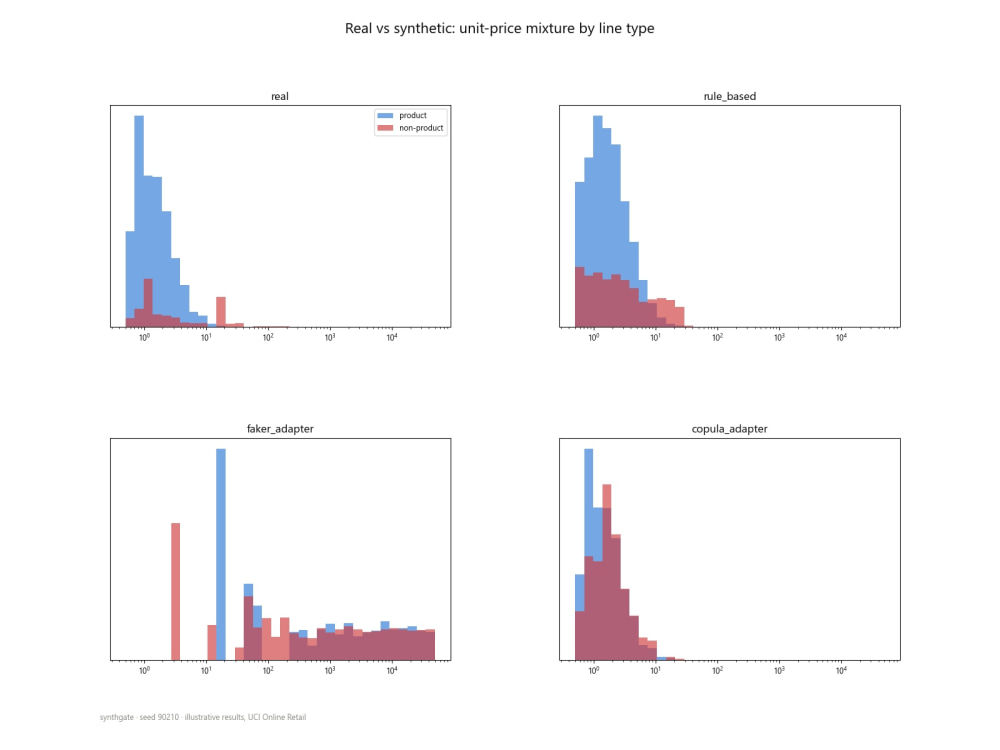
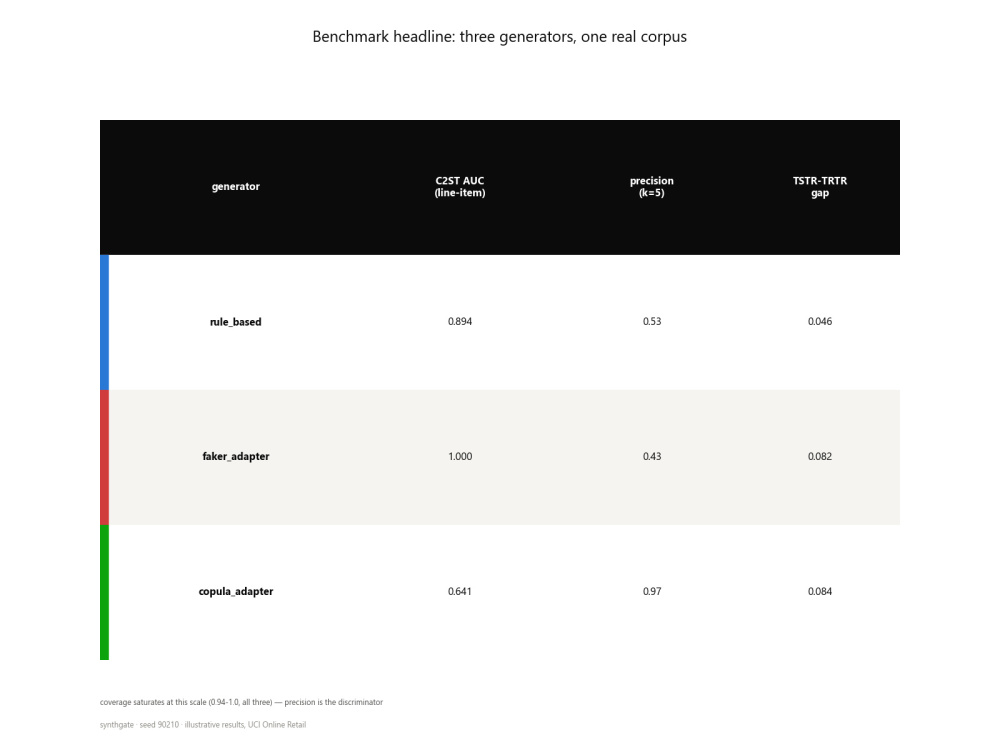
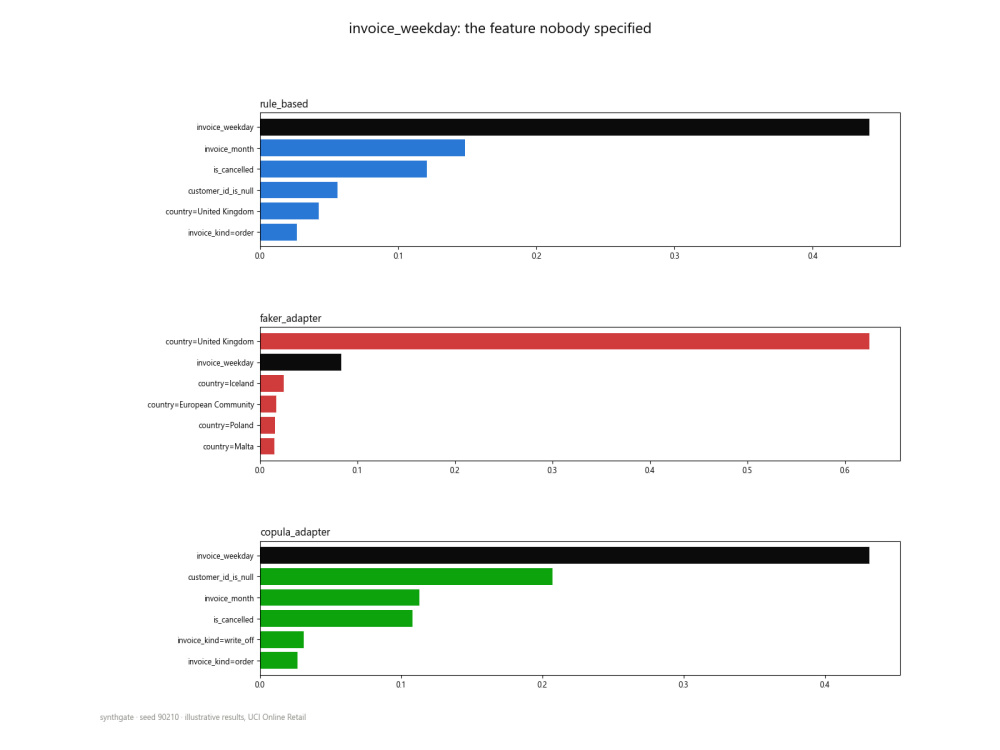
Every dataset ships with a validation report. A classifier is trained to tell your synthetic data from real data, and if it succeeds the report names which field gave it away. If it fails, the report states the smallest difference the test could have detected, because a test that could not find a problem is not proof there wasn't one. Plus precision, coverage, and leakage checks.
Generation is seeded and config-driven, so the same run reproduces byte for byte. Schema constraints are enforced across records, not just per field. Messiness is designed: typos matched to how the field was entered, missingness that depends on the value hidden, contradictions passing field-level checks.
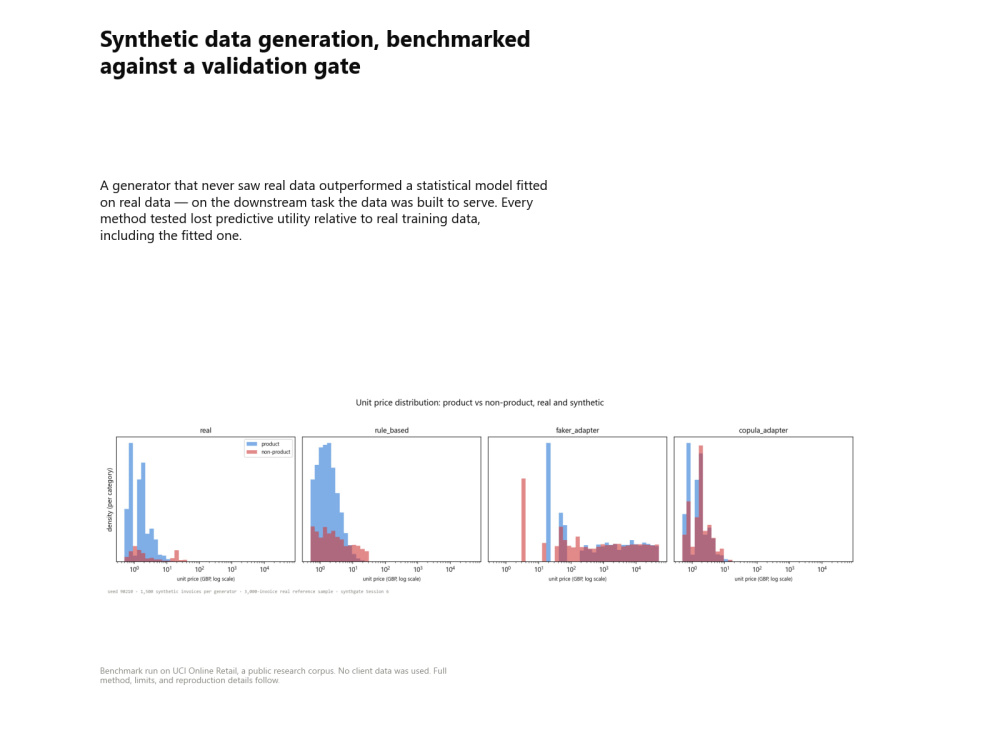
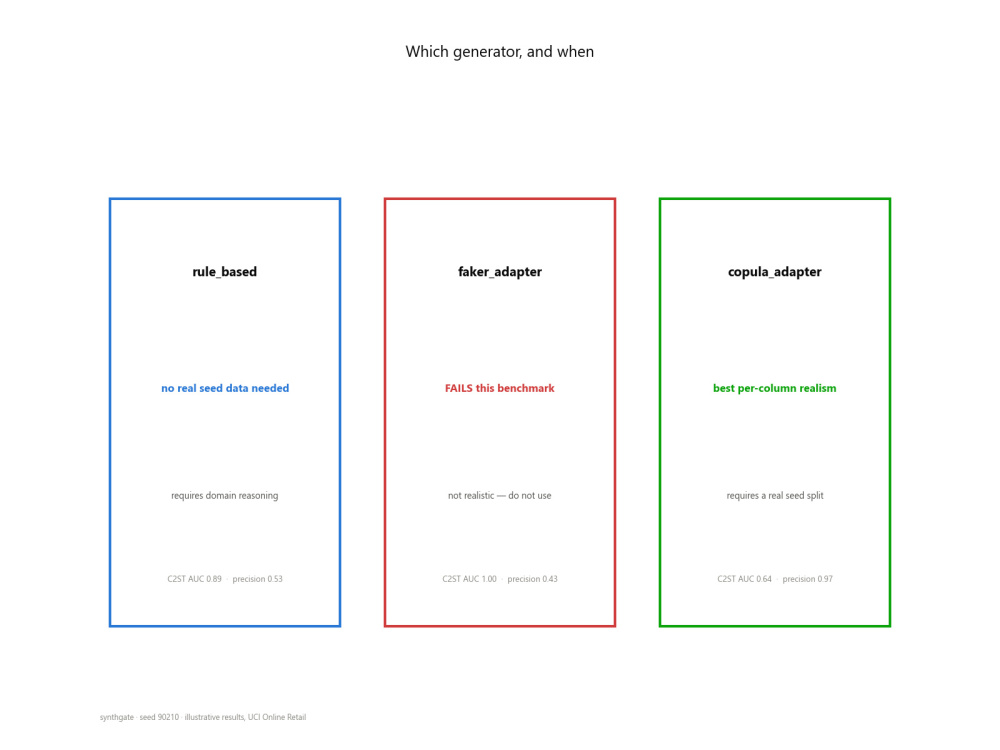
If the gate says the output is not good enough, the report says so. My benchmark reports one of my own methods failing outright.
Most synthetic data is delivered as a file and a promise. You get told it is realistic, and find out whether that was true when a model trained on it underperforms. I deliver the records and the evidence.
Every dataset ships with a validation report. A classifier is trained to tell your synthetic data from real data, and if it succeeds the report names which field gave it away. If it fails, the report states the smallest difference the test could have detected, because a test that could not find a problem is not proof there wasn't one. Plus precision, coverage, and leakage checks.
Generation is seeded and config-driven, so the same run reproduces byte for byte. Schema constraints are enforced across records, not just per field. Messiness is designed: typos matched to how the field was entered, missingness that depends on the value hidden, contradictions passing field-level checks.
If the gate says the output is not good enough, the report says so. My benchmark reports one of my own methods failing outright.
AI Algorithms
Generative Adversarial Network, Linear Discriminant Analysis, Regression AnalysisAI Applications
AI-Enhanced Classification, Anomaly Detection, Synthetic Data GenerationAI Development Language
PythonAI Models
Naive Bayes ClassifierWhat's included $150
These options are included with the project scope.
$150
- Delivery Time 2 days
- Number of Revisions 5
- Detailed Code Comments
- Model Documentation
- Model Testing & Optimization
- Source Code
Optional add-ons
You can add these on the next page.
Fast 1 Day Delivery
+$50
Additional Revision
+$10Frequently asked questions
About Bhavin
Data science, Automation, ETL and Machine learning
Surat, India - 1:49 pm local time
For the past year I worked as a quantitative researcher at a global trading
firm, where I built an autonomous pipeline that runs hypothesis → validated
result → report in a single unattended, multi-day run. That taught me the part
most AI automation skips: an agent that fails silently is worse than no agent.
So I engineer the guardrails — gating, retries, audit trails, human sign-off on
anything irreversible — as carefully as the capabilities.
WHAT I BUILD
Data engineering & ETL — ingestion from APIs, databases, files and scraped
sources; schema design, incremental loads, deduplication and entity resolution.
Python · DuckDB · Postgres · Parquet · pandas. Pipelines that are idempotent,
monitored, and safe to re-run.
AI agents & LLM systems — agentic workflows over your own APIs and tools;
extraction from documents and unstructured text with schema enforcement and
citation-grounded output; RAG; batch processing at scale; and fixes for
demo-grade agents that break in production. Claude Code · MCP · Agent SDK · REST.
Machine learning — feature engineering, model selection, time-aware and
walk-forward validation, calibration, honest error analysis.
scikit-learn · LightGBM · statsmodels.
Analytics & reporting — exploratory analysis, hypothesis testing, dashboards,
and a write-up that says what the data actually supports.
SCALE
I run an independent research program on reconstructed L3 order-book data —
2.3B+ messages — so large, messy, high-volume datasets are normal for me rather
than exceptional.
HOW I WORK
Discipline you can inspect: a registry of dead ends, drafts I retract when the
data was wrong, replication failures reported next to successes. An audit trail
you can trust, not just a result.
Tell me what you're trying to automate or figure out, and I'll tell you honestly
whether the approach is right — including when it isn't.
Steps for completing your project
After purchasing the project, send requirements so Bhavin can start the project.
Delivery time starts when Bhavin receives requirements from you.
Bhavin works on your project following the steps below.
Revisions may occur after the delivery date.
Schema review and spec sign-off
I turn your schema into a versioned spec: types, ranges, vocabularies, and cross-record constraints. You confirm it before any data is generated.
Generation with seeded, reproducible runs
Records generated to spec with a fixed seed and config, so the same run reproduces byte for byte. Library versions recorded in the manifest.