You will get API Integration | Two-Way Data Sync | Webhook & CRM Integration Expert
Project details
Two systems that were never meant to talk to each other, made to, on a schedule, with nobody pressing a button.
CRM to spreadsheet, database to dashboard, form to database, or anything with a REST API. Also the ones with no clean export, where the data comes from a layer below the official interface.
What makes this different from a script written in an afternoon:
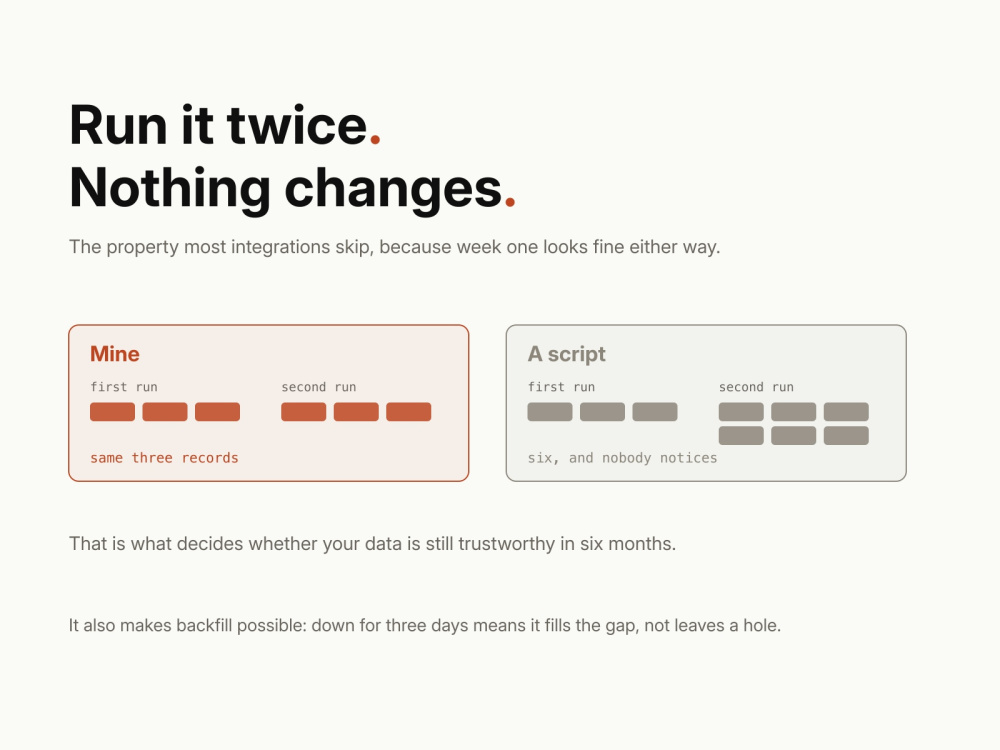
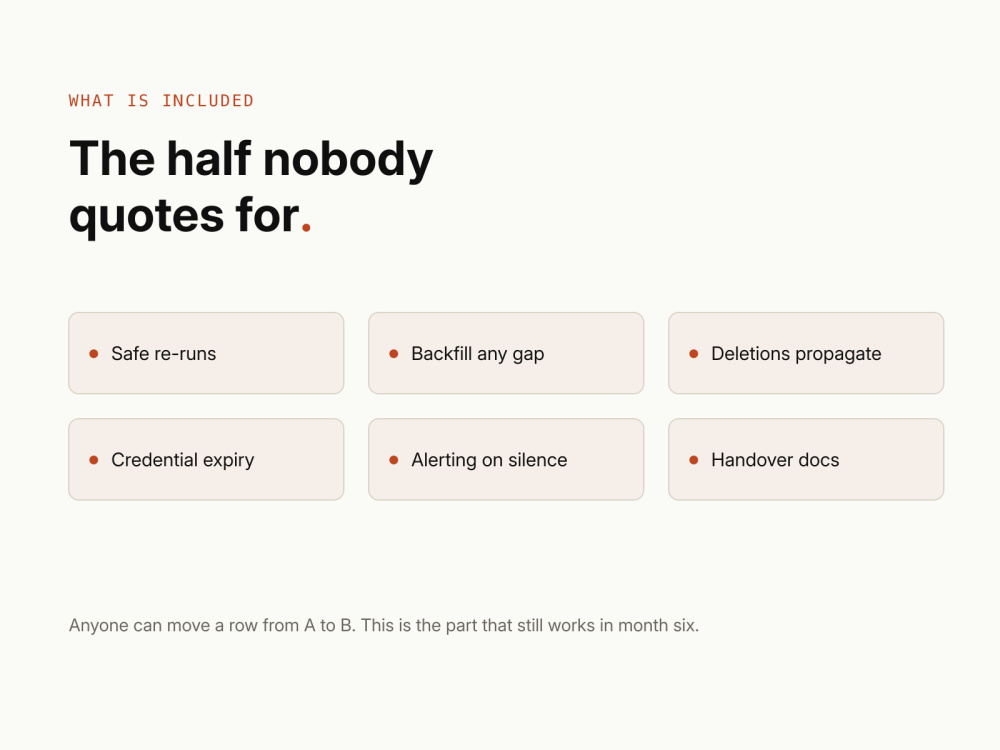
Re-running it never duplicates or corrupts anything. That single property decides whether your data is still trustworthy in six months, and most integrations skip it because week one looks fine either way.
It can backfill: down for three days means it fills the gap.
Deletions propagate: a record removed on one side does not live on forever on the other.
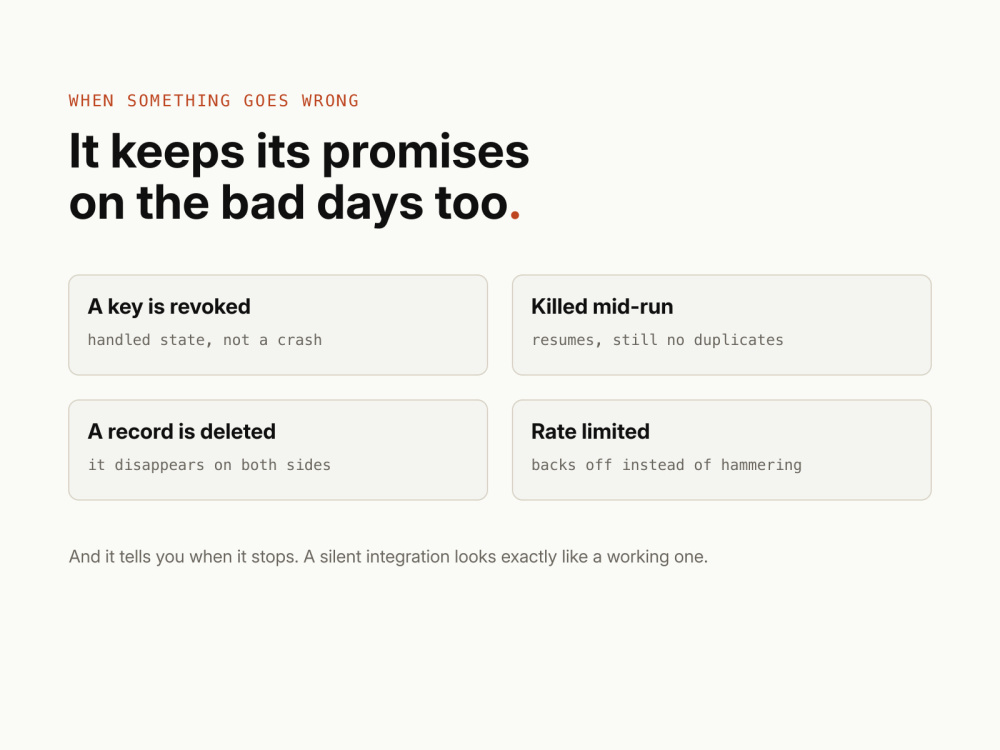
Credentials that expire are a handled state, not a crash.
And it tells you when it stops. A silent integration and a working one look identical from outside, which is how people lose a month of data.
Eleven years running production servers under 24/7 SLAs, and a pipeline of my own running unattended since 2016 at ~1,150 items a month, each with a generated image. On free provider tiers that architecture has headroom for roughly fifty thousand a month.
CRM to spreadsheet, database to dashboard, form to database, or anything with a REST API. Also the ones with no clean export, where the data comes from a layer below the official interface.
What makes this different from a script written in an afternoon:
Re-running it never duplicates or corrupts anything. That single property decides whether your data is still trustworthy in six months, and most integrations skip it because week one looks fine either way.
It can backfill: down for three days means it fills the gap.
Deletions propagate: a record removed on one side does not live on forever on the other.
Credentials that expire are a handled state, not a crash.
And it tells you when it stops. A silent integration and a working one look identical from outside, which is how people lose a month of data.
Eleven years running production servers under 24/7 SLAs, and a pipeline of my own running unattended since 2016 at ~1,150 items a month, each with a generated image. On free provider tiers that architecture has headroom for roughly fifty thousand a month.
Programming Languages
JavaScript, Python, TypeScriptCoding Expertise
Performance Optimization, SecurityWhat's included
| Service Tiers |
Starter
$150
|
Standard
$600
|
Advanced
$1,500
|
|---|---|---|---|
| Delivery Time | 2 days | 6 days | 12 days |
Number of Revisions | 0 | 1 | 2 |
Install Script | |||
Test Script | - | ||
Task Automation |
Optional add-ons
You can add these on the next page.
Fast Delivery
+$60 - $350
Additional Revision
+$80
One more entity or endpoint
(+ 3 Days)
+$250About Kirill
AI Automation Engineer | Python, LLM & API Integrations, AI Agents
Batumi, Georgia - 8:42 pm local time
Most developers hand you the code and walk away; most system administrators do not write the code. I can take a project from an empty server to a running service and then keep it running. That is the whole offer.
What I do:
- API and system integration — REST, webhooks, OAuth, rate limits, retries, and idempotent re-runs that never duplicate your data
- AI and LLM integration — summarization, classification, extraction, agents that call your tools, with provider fallback instead of vendor lock-in
- Automation and data pipelines — scraping, scheduled jobs, queues, and state that survives a restart
- Bots — Telegram, WhatsApp, Slack: multi-step flows, admin panels, payments, analytics
- Deployment and monitoring — on your server, under systemd, with logs and alerts, so you hear about a problem from a message and not from your client
The pipeline above is the proof: rewritten from scratch four times, the current version live since May 2026. RSS in, an LLM writes the summary, tags and image, out to Telegram. The volume is a setting, not a ceiling — free provider tiers alone allow roughly 50,000 items a month. It runs on a cascade of around ten LLM providers, so a dead provider degrades one item instead of stopping the run.
From the systems administration years: databases up to 10 TB, and a full migration of a company off hosted SaaS onto self-hosted infrastructure it still runs on. Degree in software engineering.
Python is my main language; the stack follows the problem. I have shipped Node.js, PHP and Bash in production and kept Java services alive.
I work in small, testable steps, and I will tell you when something is a bad idea before we build it rather than after. Happy to start with a small paid task so you can see how I work.
Steps for completing your project
After purchasing the project, send requirements so Kirill can start the project.
Delivery time starts when Kirill receives requirements from you.
Kirill works on your project following the steps below.
Revisions may occur after the delivery date.
You give me access to both systems, a sandbox is fine to start
API keys or a test account for each side. If one of them has no proper API, say so now: it is usually still possible, but it changes the approach and I would rather tell you that before you pay.
We agree what counts as a duplicate before any code exists
Which field identifies the same record on both sides, what should happen when one is deleted, and how fresh the data actually needs to be. Twenty minutes here prevents the rewrite most integrations need later.