You will get your LLM and infrastructure costs cut, with the savings measured
Project details
Most teams shipping LLM features pay far more than they need to, and cannot say which feature is responsible. The bill arrives as one number.
I find where that money goes, and cut it without degrading what your users get.
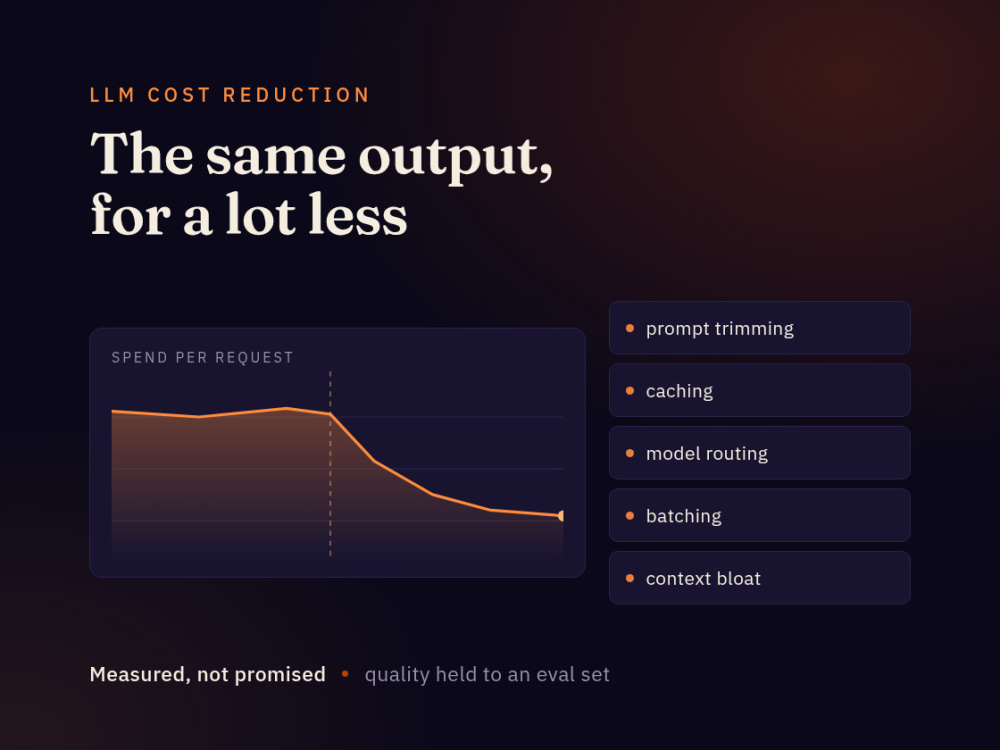
Typical findings: prompts carrying context nobody reads, retrieval stuffing twenty chunks where four would do, a frontier model doing a classification job a small one handles fine, no caching on prompts that repeat all day, retries that quietly double spend, and batching left on the table.
What I do:
• Break your spend down per feature, endpoint, model and prompt
• Rank every saving by money saved against hours to implement, with the risk stated plainly
• On the paid tiers, implement the changes myself and prove quality held using an eval set
• Ship everything behind config, so any change is one flag away from being reverted
You get a written report, the numbers behind it, and a before-and-after measurement. If there are no meaningful savings to be had, you get that in writing too, with the reasoning.
Background: twenty years building software, the last years on production LLM and agent systems in TypeScript and Python.
I find where that money goes, and cut it without degrading what your users get.
Typical findings: prompts carrying context nobody reads, retrieval stuffing twenty chunks where four would do, a frontier model doing a classification job a small one handles fine, no caching on prompts that repeat all day, retries that quietly double spend, and batching left on the table.
What I do:
• Break your spend down per feature, endpoint, model and prompt
• Rank every saving by money saved against hours to implement, with the risk stated plainly
• On the paid tiers, implement the changes myself and prove quality held using an eval set
• Ship everything behind config, so any change is one flag away from being reverted
You get a written report, the numbers behind it, and a before-and-after measurement. If there are no meaningful savings to be had, you get that in writing too, with the reasoning.
Background: twenty years building software, the last years on production LLM and agent systems in TypeScript and Python.
AI Algorithms
Large Language Model, Multimodal Large Language Model, Transformer ModelAI Applications
AI Chatbot, AI-Enhanced Classification, AI-Generated Code, AIOps, Anomaly Detection, Conversational AI, Natural Language Generation, Natural Language UnderstandingAI Development Language
PythonAI Tools
Azure OpenAI, GitHub Copilot, Hugging FaceAI Models
BERT, ChatGPT, GPT-3, GPT-4, LLaMA, OpenAI CodexWhat's included
| Service Tiers |
Starter
$750
|
Standard
$1,500
|
Advanced
$3,000
|
|---|---|---|---|
| Delivery Time | 5 days | 10 days | 21 days |
Number of Revisions | 1 | 2 | 3 |
AI Model Integration | - | ||
Batch Normalization | - | - | - |
Database Integration | - | - | |
Detailed Code Comments | - | - | |
Image Upscaling | - | - | - |
MLOps | - | - | |
Model Deployment | - | - | |
Model Documentation | |||
Model Monitoring | - | ||
Model Testing & Optimization | |||
Model Tuning | - | ||
Natural Language Processing | - | - | - |
NLP Tokenization | |||
Pre-Training | - | - | - |
Prompt Engineering | - | ||
Setup File | - | - | |
Source Code | - |
Frequently asked questions
About Jan Hein
AI Agent and LLM Architect - RAG, MCP, TypeScript, Python
Rotterdam, Netherlands - 1:45 am local time
Behind that: 20+ years as a software architect (PhD) and founder/CTO of several startups. I have been shipping LLM-based workflows since 2019, well before the current wave, and I take ownership of the outcome, not just the tickets.
What I do:
- AI agents and LLM integration - multi-agent architectures, tool and function calling, MCP servers, agent orchestration
- RAG and knowledge infrastructure - retrieval pipelines, embeddings, organisational memory that stays accurate
- Architecture and technical review - is your approach going to survive production? Build-vs-buy, scaling, cost
- Rescue and take-over - inheriting a half-finished codebase and making it stable and shippable
- Full-stack and DevOps - polyglot: TypeScript/Node/Bun, Python, Elixir, Clojure; containers, IaC, CI/CD, self-hosted deployment
How I work:
I am senior enough to work unsupervised. I have been the CTO, so I can own a system end to end or drop into an existing team and stabilise it. I will tell you when the thing you asked for is not the thing you need.
Based in Taipei (UTC+8) - full working-day overlap with Asia-Pacific, and mornings overlap with Europe. Contracted through my Dutch company: proper invoicing, contracts and IP assignment.
Available 15-20 hrs/week, starting immediately.
Steps for completing your project
After purchasing the project, send requirements so Jan Hein can start the project.
Delivery time starts when Jan Hein receives requirements from you.
Jan Hein works on your project following the steps below.
Revisions may occur after the delivery date.
Baseline: what you actually spend, and on what
I break your bill down by feature, endpoint, model and prompt, so we stop guessing. You get one number per code path and a clear picture of which few calls carry most of the cost.
The savings list, ranked by money saved per hour of work
Prompt trimming, caching, smaller models on the easy paths, batching, retry and context waste. Each item gets an estimated monthly saving and an honest note on what it risks.