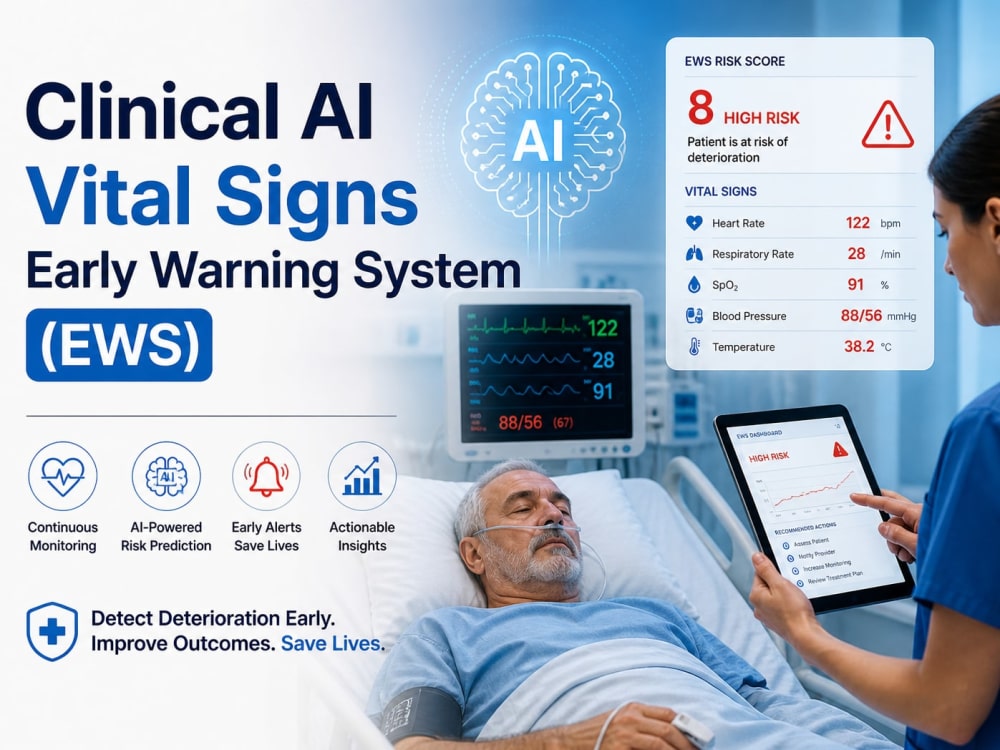
You will get a Clinical AI Vital Signs Early Warning System (EWS)
Project details
Strategic Infection Risk Forecasting: A Clinical-First AI Approach
Healthcare-Associated Infections (HAIs) in long-stay patients are not just data
problems—they are clinical crises and financial liabilities. Generic data
science often fails because it cannot distinguish biological noise from
life-saving triggers. My Vital Signs Infection Forecasting Engine bridges this
gap. Led by an SME certified in Epidemiology and Vital Signs, we utilize an
SME-Led, AI-Augmented framework to deliver validated results with 48-hour
turnaround.
Our proprietary methodology integrates CDC/NHSN surveillance definitions
and AHRQ toolkits to identify "Infection Signatures" 12 hours before clinical
fever occurs. By mapping these signals into evidence-based WHO IPC workflows, we
ensure every alert is legally and clinically defensible.
Using GCP Dataflow and
BigQuery, we transform siloed patient data into a high-speed analytical
pipeline. The result is a SHEA-calibrated dashboard in Data Studio that
eliminates alarm fatigue.
Secure your ward with clinical-grade AI. Get 48-hour proof for $1,500 and scale
to a full GCP safety ecosystem.
Message me your idea and get a Free AI Tech Check
Healthcare-Associated Infections (HAIs) in long-stay patients are not just data
problems—they are clinical crises and financial liabilities. Generic data
science often fails because it cannot distinguish biological noise from
life-saving triggers. My Vital Signs Infection Forecasting Engine bridges this
gap. Led by an SME certified in Epidemiology and Vital Signs, we utilize an
SME-Led, AI-Augmented framework to deliver validated results with 48-hour
turnaround.
Our proprietary methodology integrates CDC/NHSN surveillance definitions
and AHRQ toolkits to identify "Infection Signatures" 12 hours before clinical
fever occurs. By mapping these signals into evidence-based WHO IPC workflows, we
ensure every alert is legally and clinically defensible.
Using GCP Dataflow and
BigQuery, we transform siloed patient data into a high-speed analytical
pipeline. The result is a SHEA-calibrated dashboard in Data Studio that
eliminates alarm fatigue.
Secure your ward with clinical-grade AI. Get 48-hour proof for $1,500 and scale
to a full GCP safety ecosystem.
Message me your idea and get a Free AI Tech Check
AI Development Type
Deep Learning, Knowledge Representation, Model TuningAI Tools
Google AutoML, Keras, MATLAB, PyTorch, TensorFlowAI Development Language
PythonWhat's included
| Service Tiers |
Starter
$1,500
|
Standard
$3,000
|
Advanced
$4,850
|
|---|---|---|---|
| Delivery Time | 2 days | 10 days | 15 days |
Number of Revisions | 1 | 2 | |
AI Model Integration | - | ||
Detailed Code Comments | |||
Knowledge Graph | - | ||
Model Documentation | |||
Ontology | - | ||
Source Code | |||
Taxonomy | - |
2 reviews
(2)
(0)
(0)
(0)
(0)
This project doesn't have any reviews.
MA
Memoona A.
Jul 13, 2023
Senior Google Cloud Dataflow and Dataproc Developer
DR
David R.
May 21, 2021
Explore and model data set distributions
happy to work with him hire again soon
About Rufaro L
Predictive AI Engineer | Clinical Risk, AMR & AgriTech Biosecurity
Mutare, Zimbabwe - 7:18 pm local time
As an AI and Data Science specialist focused on Healthcare Analytics, Clinical Risk Analytics, and Precision Agriculture, I help small and medium organizations move from reactive data collection to predictive action — without the complexity or cost of enterprise-level infrastructure. Whether I am modeling infectious disease trends in a clinical setting or optimizing feed conversion on a livestock operation, my solutions are built around your specific KPIs and your team's daily workflows.
DOMAIN EXPERTISE 1: HEALTH SCIENCE & HEALTHCARE
Key Domain Problems I Solve:
I address critical challenges in clinical risk management, including identifying high-risk patient groups, forecasting hospital-acquired infections (HAIs), and monitoring Antimicrobial Resistance (AMR). My work prevents costly health outbreaks and improves patient outcomes through early warning systems that trigger action before a crisis develops.
Key Services & Successful Projects:
Predictive Risk Scoring: I build models that link symptom progression to discharge or mortality likelihood.
Infection Risk Forecasting: I create analytics that correlate hospital stay length with HAI risks to prioritize clinical care.
Project Success: AI-Driven Risk Detection for Hospital Patients – Formulated domain-grounded methodologies to identify high-risk groups based on clinical risk trigger mapping.
Project Success: AMR Monitoring – Provided data science guidance for Anti-Microbial Resistance, delivering AI-powered biosecurity assessment tools to fight drug-resistant infections.
Credentials: Epidemiology & Public Health Specialization, Vital Signs Physiology, University training in Data Modeling, Systems Design & Information Systems. Microsoft Professional Data Science Certification and DeepLearning.AI credentials.
DOMAIN EXPERTISE 2: LIVESTOCK OPERATIONS
Key Domain Problems I Solve:
I help livestock SMBs tackle the 6–12% of feed energy lost to inefficiency and detect metabolic health risks (like ketosis or acidosis) before they impact yield. I solve the "messy data" problem on farms to improve feed-to-weight ratios and pasture recovery — turning operational chaos into a competitive edge.
Key Services & Successful Projects:
Feed & Pasture Optimization: AI models for biomass recovery and grazing event prediction.
Health & Biosecurity Monitoring: Audio and structured data analytics for early disease detection.
Project Success: Grazing Event Prediction – Built models for 1M+ cattle to estimate days since grazing, significantly improving pasture recovery and rotation schedules.
Project Success: Feed Efficiency Monitoring – Applied statistical and AI methods to detect subclinical losses and optimize feed ROI.
Credentials: Certified in Animal Agriculture (Dairy, Poultry, Beef, and Swine). Academic Foundation in AI, LISP, Economics and Operations Research. Google Cloud Certifications in Data Engineering and Machine Learning for scalable Vertex AI and BigQuery pipelines.
MY METHODOLOGY: WHY SMBs CHOOSE ME
Unlike large consulting firms that deliver reports you cannot act on, I follow a three-phase Trusted Methodology that keeps your team in control at every step — and ensures my technical skills are never "black boxes."
Phase 1 — Discovery & Needs Assessment:
I map your workflows using Generative AI and define quantifiable KPIs (e.g., "Reduce feed waste by 10%" or "Flag high-risk patients 48 hours earlier").
Phase 2 — Design & Blueprint:
I select algorithms based on your domain science and design AI Touchpoints that fit your team's daily SOPs — not the other way around.
Phase 3 — Build & Implement:
I deliver automated, serverless pipelines (GCP Dataflow/Vertex AI) with simple, actionable outputs like traffic-light alerts your team can act on immediately.
READY TO SEE RESULTS BEFORE YOU COMMIT?
I offer a low-risk Proof of Concept (POC) that demonstrates exactly how this Methodology will solve your specific challenge — so you can evaluate real results before committing to a full engagement.
Invite me to your job post or send a direct message — and let's turn your domain data into a scalable, automated engine for growth.
Steps for completing your project
After purchasing the project, send requirements so Rufaro L can start the project.
Delivery time starts when Rufaro L receives requirements from you.
Rufaro L works on your project following the steps below.
Revisions may occur after the delivery date.
Domain Taxonomy & Ground Truth Establishment
I use my Epidemiology Certification and a Multi-Persona AI Facility to classify raw clinical data against CDC/NHSN Surveillance Definitions. This ensures we are correctly identifying clinically confirmed Hospital-Acquired Infections (HAIs).
Physiological Risk-Trigger Mapping (AHRQ Toolkit & Vital Signs Cert)
Using AHRQ Toolkit principles and Vital Signs expertise, I deploy high-speed AI agents to scan the data for "hidden" signatures This step identifies the exact triggers that precede an infection event by 12–48 hours.