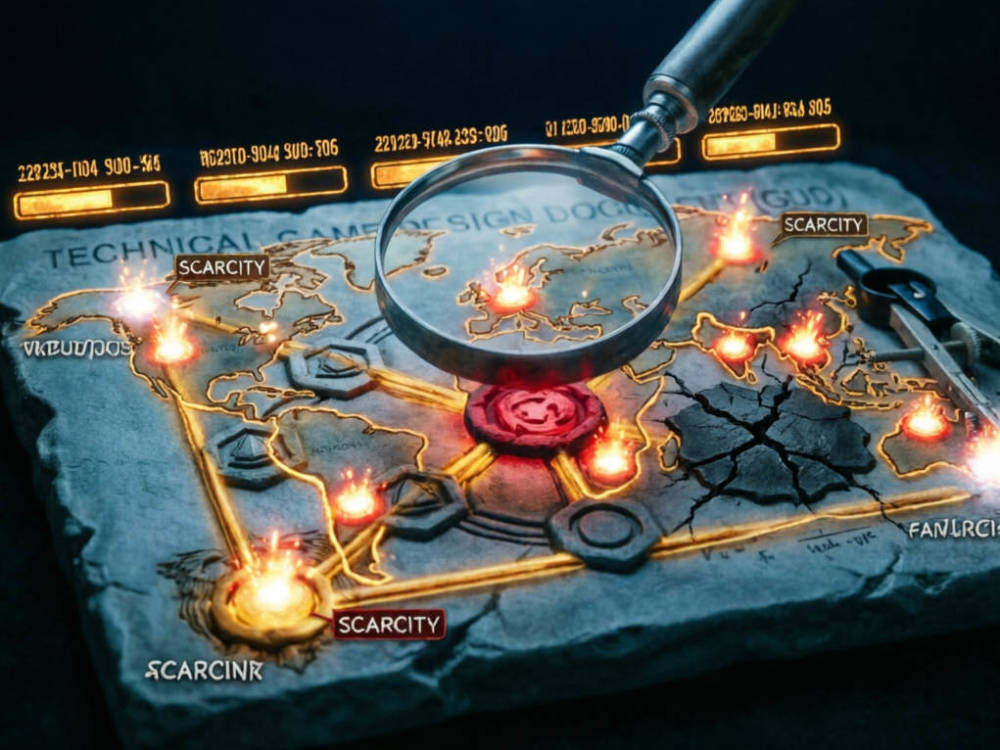
You will get a designed dynamic world-state and live event system for your online game
Project details
The difference between a world that feels alive and one that feels like a theme
park is whether the world has memory.
A theme park resets. A living world accumulates — player choices shift faction
standing, world events alter resource availability, political decisions leave marks
that players who arrive months later can still see evidence of.
I design world-state systems: the architecture underneath the visible game that
tracks health, consequence, and change. The systems that make a player feel like
they matter to the world, not just to their own character sheet.
WHAT YOU RECEIVE:
World-state variable architecture, faction health or drift system design, dynamic
event framework with escalation logic, permanent consequence design, player-agency
integration, and live service event tier architecture.
BEST FOR: Online game developers building persistent worlds where player actions
need to mean something after the session ends.
park is whether the world has memory.
A theme park resets. A living world accumulates — player choices shift faction
standing, world events alter resource availability, political decisions leave marks
that players who arrive months later can still see evidence of.
I design world-state systems: the architecture underneath the visible game that
tracks health, consequence, and change. The systems that make a player feel like
they matter to the world, not just to their own character sheet.
WHAT YOU RECEIVE:
World-state variable architecture, faction health or drift system design, dynamic
event framework with escalation logic, permanent consequence design, player-agency
integration, and live service event tier architecture.
BEST FOR: Online game developers building persistent worlds where player actions
need to mean something after the session ends.
Platform Type
PC, Mobile Device, ConsoleGenre
Action, Adventure, Arcade, Shooter, Racing, Role Playing, Simulation, Strategy, Card, MultiplayerPlugins
Analytics, SocialWhat's included
| Service Tiers |
Starter
$175
|
Standard
$400
|
Advanced
$850
|
|---|---|---|---|
| Delivery Time | 4 days | 8 days | 12 days |
Number of Revisions | 1 | 2 | 3 |
Source Code | - | - | - |
Optional add-ons
You can add these on the next page.
Fast Delivery
+$85 - $375
Additional Revision
+$65Frequently asked questions
About Sheldon
Game Systems Architect | Lore-to-Mechanics | Pre-Code GDD Authority
Evans Mills, United States - 3:52 am local time
Over the past year, working independently with AI as my primary thinking partner, I've built two substantial, interconnected bodies of work: a constitutional AI governance and reliability framework stack, and a complete, production-ready methodology for narrative game design.
AI Reliability & Governance Architecture
I design certainty-scoring and reliability infrastructure for AI systems — frameworks that tag every claim by its epistemic status (data, reasoning, strategic projection, or open question) so nothing is presented as more certain than it actually is. This includes FSVE, a scoring engine for AI outputs that has gone through repeated internal red-team revision cycles to close gaps as they're found, and a complete cryptographic timestamping and sealing protocol for provenance and audit trails.
World & Systems Design
I architect game worlds the way I architect AI governance — as interlocking, internally consistent systems that hold up under adversarial pressure. I built a reusable AAA-tier lore/story-bible methodology, then used it to produce a full portfolio demonstration: The Salary of a Dream, a narrative RPG lore bible grounded in primary-source Shinto mythology (Kojiki, Nihon Shoki) and Ainu tradition, with every faction's design directly derived from a documented myth rather than invented from scratch.
The companion Lore-to-Systems Bridge document translates that narrative foundation into a complete systems-design vocabulary — variable architecture, progression gates, NPC behavior state machines, and a full data model — without prescribing engineering, so a systems team can scope a real GDD directly from it. Together, the two documents demonstrate the full pipeline: myth research → cosmology → faction architecture → systems translation → production handoff.
How I work
Every framework I build — whether it governs an AI system or a fictional world — goes through adversarial self-review before I call it done. I actively try to break my own designs before showing them to anyone else. I'd rather tell you what's unproven and what's solid than blur the line for the sake of a better pitch.
ORCID: 0009-0005-8057-5115
Steps for completing your project
After purchasing the project, send requirements so Sheldon can start the project.
Delivery time starts when Sheldon receives requirements from you.
Sheldon works on your project following the steps below.
Revisions may occur after the delivery date.
World and faction state mapping
I map all factions, political relationships, and world variables that need to be tracked — building the state inventory before architecture begins.
State variable and health system design
World-state variable architecture defined. Faction health and drift systems specified. The tracking infrastructure is built before events are layered on.