You will get a PostgreSQL performance audit with query-level fixes
Project details
Slow queries compound quietly. A 200ms query that runs 50 times per page load adds 10 seconds of invisible latency. A missing index on a 2M-row table means every lookup is a sequential scan. A connection pool sized at defaults exhausts under moderate traffic.
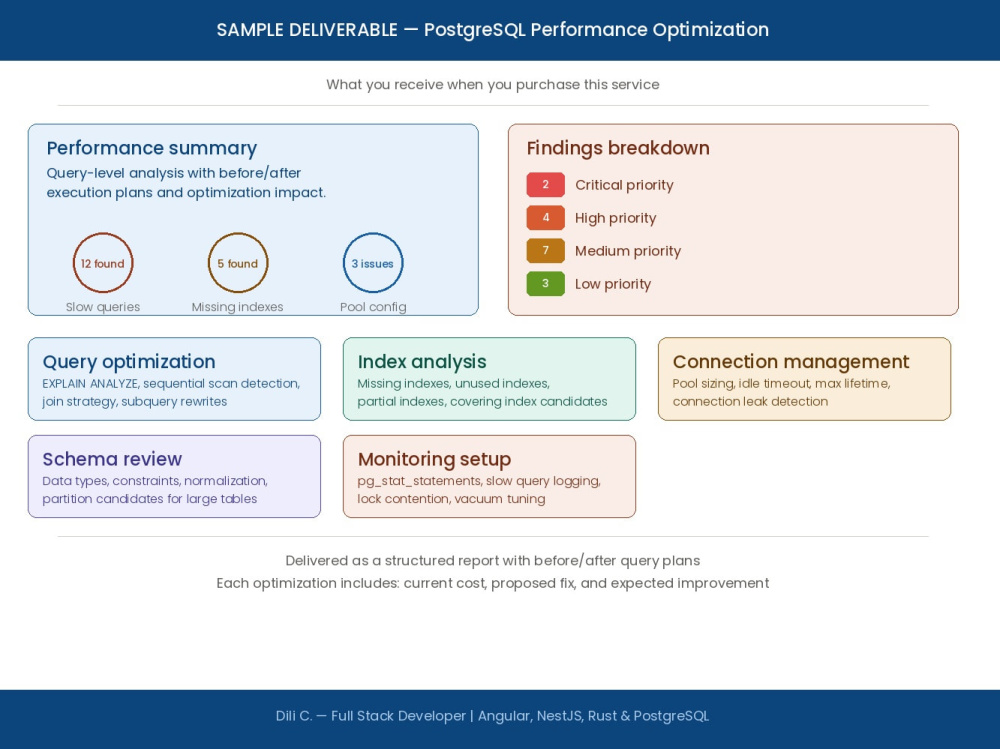
I profile your PostgreSQL instance at the query level — EXPLAIN ANALYZE on your heaviest endpoints, index gap analysis, connection pool configuration, schema review, and monitoring setup. Every finding comes with the current execution cost, the proposed fix, and the expected improvement.
My own production database uses a dual-pool architecture — sqlx with compile-time verified SQL for type-safe queries, and deadpool-postgres with pipelining for batch operations — so the recommendations come from working with PostgreSQL at the level where pool configuration and query planning actually matter.
I profile your PostgreSQL instance at the query level — EXPLAIN ANALYZE on your heaviest endpoints, index gap analysis, connection pool configuration, schema review, and monitoring setup. Every finding comes with the current execution cost, the proposed fix, and the expected improvement.
My own production database uses a dual-pool architecture — sqlx with compile-time verified SQL for type-safe queries, and deadpool-postgres with pipelining for batch operations — so the recommendations come from working with PostgreSQL at the level where pool configuration and query planning actually matter.
Database Type
PostgreSQLWhat's included
| Service Tiers |
Starter
$300
|
Standard
$600
|
Advanced
$900
|
|---|---|---|---|
| Delivery Time | 3 days | 5 days | 7 days |
Number of Revisions | 1 | 1 | 2 |
Query Debugging | - | - | - |
Query Optimization | - | ||
Query Scheduling | - | - | - |
Query Analysis | - | ||
Source Code | - |
Frequently asked questions
About Dili
Full Stack Developer | Angular, NestJS, Rust & PostgreSQL
San Francisco, United States - 11:00 am local time
This isn't Rust bolted onto a Node stack as an afterthought. In my architecture, Rust is the default implementation layer: business logic, data transformation, cryptography (Argon2id, JWT signing), and database queries via sqlx with compile-time verified SQL. A dual-pool PostgreSQL setup - sqlx for the 95% of queries that benefit from compile-time checking, deadpool-postgres with tokio-postgres pipelining for batch-critical paths - keeps correctness and throughput from competing with each other. Security is baked in at every layer - constant-time comparison in Rust, Content Security Policy, Trusted Types, and custom ESLint rules blocking unsafe patterns. NestJS handles what it's genuinely best at - routing, dependency injection, middleware, request lifecycle - and delegates everything else across the napi boundary.
I'm currently building Afterlife Licorice, a journal and civic media platform with real-time public data monitoring and verified sources. The entire backend runs on this pattern: coarse-grained napi exports per domain, feature-gated bindings so all core logic is testable without Node.js, and pedantic Clippy lints enforced as errors across the workspace.
I take on a limited number of projects at a time. If you're working with Angular, NestJS, Rust, or PostgreSQL - or you're trying to figure out where Rust fits in a Node.js stack - send me a message describing what you're building.
Steps for completing your project
After purchasing the project, send requirements so Dili can start the project.
Delivery time starts when Dili receives requirements from you.
Dili works on your project following the steps below.
Revisions may occur after the delivery date.
Query profiling and baseline measurement
I run EXPLAIN ANALYZE on your heaviest queries, check pg_stat_statements if available, and identify sequential scans on large tables.
Index and connection pool analysis
Review existing indexes for gaps and redundancy. Analyze pool configuration against your traffic patterns and server resources.