You will get a production-ready RAG system with document Q&A powered by OpenAI
Project details
I build production-ready RAG (Retrieval-Augmented Generation) systems that let your documents answer questions in natural language.
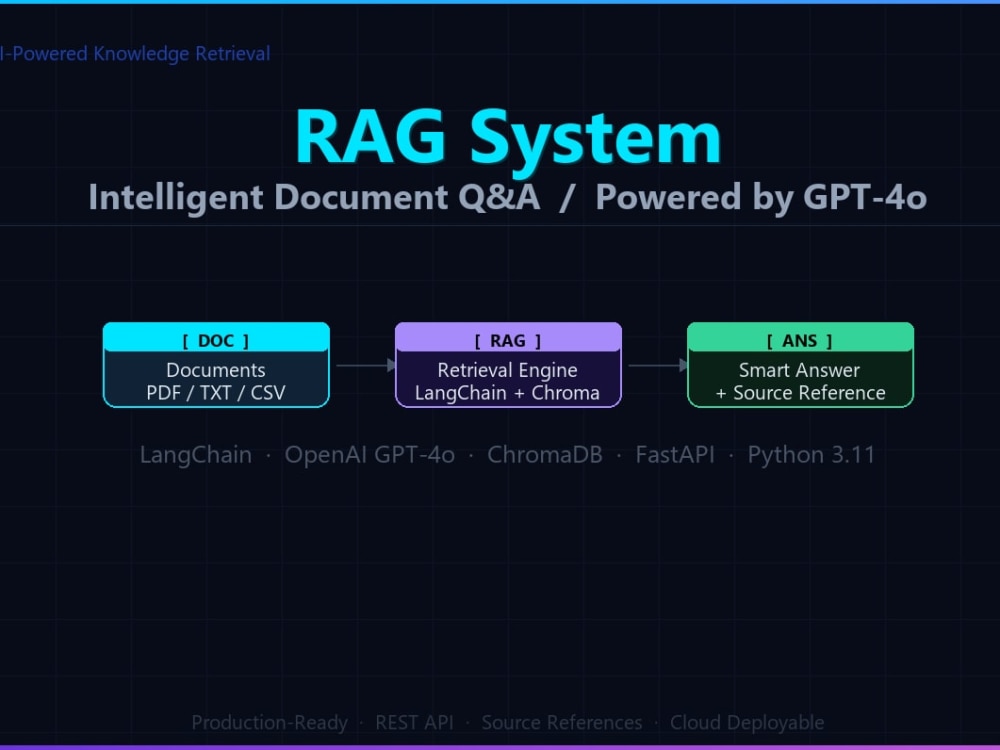
Built with LangChain, OpenAI GPT-4o, ChromaDB, and FastAPI, the system ingests your PDFs, CSVs, or text files, indexes them into a vector store, and exposes a clean REST API that returns accurate answers — with source references included.
What makes this different:
• Every answer includes the source document, so your team can verify results
• Fully production-ready: error handling, logging, and clean API structure included
• You receive working, tested code — not a prototype
I have been building and shipping AI systems daily for over 514 days. Your RAG system will be clean, documented, and ready to integrate from day one.
Built with LangChain, OpenAI GPT-4o, ChromaDB, and FastAPI, the system ingests your PDFs, CSVs, or text files, indexes them into a vector store, and exposes a clean REST API that returns accurate answers — with source references included.
What makes this different:
• Every answer includes the source document, so your team can verify results
• Fully production-ready: error handling, logging, and clean API structure included
• You receive working, tested code — not a prototype
I have been building and shipping AI systems daily for over 514 days. Your RAG system will be clean, documented, and ready to integrate from day one.
AI Algorithms
Large Language Model, Transformer ModelAI Applications
AI-Generated Code, Conversational AI, Natural Language GenerationAI Tools
Hugging Face, StreamlitAI Models
BERT, ChatGPT, GPT-4, LLaMAWhat's included
| Service Tiers |
Starter
$80
|
Standard
$150
|
Advanced
$250
|
|---|---|---|---|
| Delivery Time | 7 days | 14 days | 21 days |
Number of Revisions | 1 | 2 | 3 |
AI Model Integration | |||
Batch Normalization | - | - | - |
Database Integration | |||
Detailed Code Comments | - | - | - |
Image Upscaling | - | - | - |
MLOps | - | - | - |
Model Deployment | - | - | - |
Model Documentation | - | ||
Model Monitoring | - | - | - |
Model Testing & Optimization | - | - | - |
Model Tuning | - | - | - |
Natural Language Processing | |||
NLP Tokenization | - | - | - |
Pre-Training | - | - | - |
Prompt Engineering | - | - | - |
Setup File | - | - | - |
Source Code |
Frequently asked questions
About Kato
AI Systems Developer | RAG, Agentic Workflows, FastAPI, OpenAI
Ota, Japan - 5:27 am local time
My focus is not only calling an LLM API. I design the backend structure around it: document ingestion, retrieval, session state, structured outputs, workflow routing, human approval points, observability, and maintainable service boundaries.
What I can help you build:
* RAG / document Q&A systems using OpenAI, LangChain-style workflows, Chroma or other vector databases
* FastAPI backends for AI applications and internal tools
* Agentic workflows with clear tool boundaries, human approval gates, and fallback behavior
* AI prototypes for interactive products, assistants, writing tools, or personalized experiences
* Structured output pipelines for analysis, document review, and business workflows
* Local AI / LLM integrations using Ollama, llama.cpp, vLLM, or GPU-based tooling
* Reliability improvements: logging, endpoint checks, service extraction, and production-readiness reviews
Recent work:
I built and operate SaijinOS, a production-oriented AI system architecture with persistent conversation state, document/RAG workflows, structured reasoning pipelines, multi-agent routing, local model integration, and a FastAPI-based backend.
Recently, I refactored a large Python API entrypoint from approximately 2,249 lines to 1,554 lines by extracting clearer service-layer responsibilities while preserving API behavior. I also validated live endpoints for health checks, workflow APIs, attachment analysis, and internal routing.
I also use agentic development workflows with Codex, Copilot, and local AI tools to accelerate implementation, refactoring, testing, and troubleshooting while keeping human engineering judgment as the quality gate for architecture, security, observability, and release readiness.
My strongest project areas are:
1. RAG and document-based AI systems
2. Agentic workflow automation
3. FastAPI + OpenAI backend development
4. AI prototypes with persistent user/session state
5. Production-readiness, observability, and refactoring for AI systems
I work best with clients who want a practical AI system that can grow beyond a demo: clear architecture, controlled outputs, reliable backend behavior, and a realistic path from MVP to production.
Steps for completing your project
After purchasing the project, send requirements so Kato can start the project.
Delivery time starts when Kato receives requirements from you.
Kato works on your project following the steps below.
Revisions may occur after the delivery date.
Confirm requirements
document types, use case, and integration needs
Build document ingestion pipeline
parse, chunk, and embed your files