You will get a professional penetration testing of AI Systems with detailed report.
Project details
Your AI can be exploited. I find how, before attackers do.
AI systems can be manipulated, misused, or exploited in ways most businesses don’t expect. From prompt injection attacks to data leaks and unsafe outputs, even well-built AI applications can introduce serious security risks.
I provide AI Security Testing (AI Penetration Testing) to identify how attackers can exploit your AI system before they do. I simulate real-world adversarial scenarios to uncover vulnerabilities in chatbots, AI agents, RAG pipelines, and LLM-powered applications.
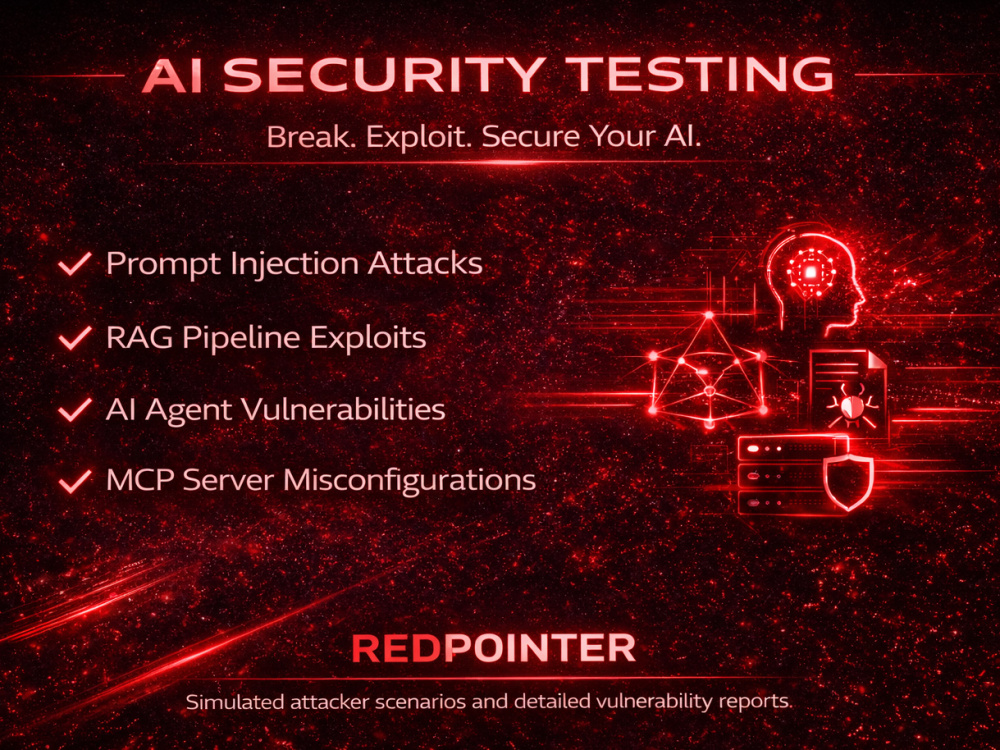
My testing includes prompt injection attacks, jailbreak attempts, data extraction risks, RAG exploitation, AI agent abuse, and MCP/server misconfigurations.
You will receive a detailed report with vulnerabilities, real attack scenarios, and clear remediation steps to secure your AI system.
If your AI handles users, data, or automation—security is not optional.
AI systems can be manipulated, misused, or exploited in ways most businesses don’t expect. From prompt injection attacks to data leaks and unsafe outputs, even well-built AI applications can introduce serious security risks.
I provide AI Security Testing (AI Penetration Testing) to identify how attackers can exploit your AI system before they do. I simulate real-world adversarial scenarios to uncover vulnerabilities in chatbots, AI agents, RAG pipelines, and LLM-powered applications.
My testing includes prompt injection attacks, jailbreak attempts, data extraction risks, RAG exploitation, AI agent abuse, and MCP/server misconfigurations.
You will receive a detailed report with vulnerabilities, real attack scenarios, and clear remediation steps to secure your AI system.
If your AI handles users, data, or automation—security is not optional.
AI Algorithms
CycleGAN, Gated Recurrent Unit, Generative Adversarial Network, Large Language Model, Linear Discriminant Analysis, Long Short-Term Memory Network, Multimodal Large Language Model, Radial Basis Function Network, StyleGAN, Transformer ModelAI Applications
AI Chatbot, AI Content Creation, AI Mobile App Development, AI Text-to-Image, AI-Enhanced Classification, AI-Enhanced Medical Imaging, AI-Generated Code, AI-Generated Music, Conversational AI, Image Analysis, Natural Language Generation, Object LocalizationAI Development Language
PythonAI Tools
Adobe Firefly, Azure OpenAI, Copy.ai, GitHub Copilot, Gradio, Hugging Face, Microsoft 365 Copilot, NVIDIA AI Platform, PyTorch, TensorFlowAI Models
AlphaCode, BERT, ChatGPT, DALL-E, GPT-3, GPT-4, GPT-J, GPT-Neo, Jurassic-2, LLaMA, Midjourney AI, OpenAI CodexWhat's included
| Service Tiers |
Starter
$150
|
Standard
$450
|
Advanced
$1,200
|
|---|---|---|---|
| Delivery Time | 5 days | 12 days | 20 days |
AI Model Integration | - | - | - |
Batch Normalization | - | - | - |
Database Integration | - | - | - |
Detailed Code Comments | - | - | - |
Image Upscaling | - | - | - |
MLOps | - | - | |
Model Deployment | - | - | - |
Model Documentation | - | - | |
Model Monitoring | - | ||
Model Testing & Optimization | |||
Model Tuning | - | - | - |
Natural Language Processing | - | ||
NLP Tokenization | - | - | - |
Pre-Training | - | - | - |
Prompt Engineering | |||
Setup File | - | - | - |
Source Code | - | - |
Frequently asked questions
About Pranav
Red Team Operator | Penetration Tester | Adversary Emulator
Pune, India - 6:17 pm local time
My work is centered on one principle. Security should be tested the way it is broken in reality.
Modern attackers do not scan and stop. They chain weaknesses together. They exploit business logic flaws. They abuse identity systems. They escalate privileges silently. They pivot across trust boundaries. They weaponize misconfigurations. They live off the land. They evade detection. They pursue objectives.
That is exactly how I test.
I specialize in simulating real adversaries across web applications, APIs, cloud infrastructure, internal networks, Active Directory environments, identity systems, DevOps pipelines, and hybrid architectures. My engagements replicate the full lifecycle of an attack from initial access to lateral movement to privilege escalation to impact validation.
My objective is not to produce a list of vulnerabilities.
My objective is to uncover real attack paths that demonstrate how an organization could be compromised under realistic conditions.
I focus on understanding how attackers actually operate in the wild. Financially motivated threat actors. Organized cybercrime groups. Ransomware operators. Internal threat actors. Cloud exploitation campaigns. Credential abuse. Token theft. Session manipulation. Business logic exploitation. API abuse. Identity takeover. Privilege escalation through configuration drift. Kerberos abuse in Active Directory environments. Cloud IAM escalation paths. OAuth misconfigurations. Webhook forgery. Transaction replay. Broken authorization in REST and GraphQL APIs.
I do not rely on automated scanners as the primary testing method. Automation is a tool. Adversarial thinking is the core.
My Red Team engagements simulate determined attackers attempting to achieve defined objectives such as sensitive data access, domain dominance, cloud account compromise, payment workflow manipulation, or identity system takeover. Every step is conducted in a controlled and ethical manner with proper authorization and clear scope.
I design engagements around realistic attack scenarios such as:
External attacker targeting exposed web applications and APIs
Compromise of a low privilege internal account followed by privilege escalation
Credential harvesting and lateral movement within enterprise networks
Cloud identity abuse through misconfigured IAM policies
Abuse of trust relationships across hybrid infrastructures
Payment flow manipulation and transaction logic exploitation
Business email compromise simulation
Data exfiltration path validation
Detection and response effectiveness testing under real attack pressure
My adversary emulation engagements are structured around real world tactics and techniques. I simulate known attacker behaviors using tradecraft that mirrors what is observed in actual breaches. This allows organizations to measure not just vulnerability exposure but operational resilience.
A critical difference in my approach is attack chain analysis. Isolated vulnerabilities are rarely catastrophic on their own. However, when chained together they become breach pathways. My methodology identifies how low severity findings combine into high impact compromise.
For web application and API security testing, I focus heavily on authentication and authorization weaknesses, IDOR vulnerabilities, privilege boundary failures, insecure direct object references, broken access control, session fixation, token manipulation, mass assignment, rate limit bypass, server side request forgery, injection flaws, deserialization risks, and complex business logic abuse that automated tools cannot detect.
For cloud environments, I assess identity and access management, role trust policies, privilege escalation paths, exposed storage buckets, overly permissive security groups, container escape risks, metadata service abuse, CI CD pipeline weaknesses, and cross account trust exploitation.
For internal network testing, I evaluate domain configurations, credential storage practices, Kerberos delegation issues, NTLM relay potential, Active Directory privilege escalation paths, service account misuse, and lateral movement exposure.
For organizations handling financial data or operating in regulated industries, I align testing objectives with compliance frameworks such as PCI DSS, SOC 2, ISO 27001, and regional cybersecurity regulations. However, my goal is always to go beyond compliance validation and measure actual breach potential.
Security is not about passing audits. It is about preventing compromise.
My reporting is structured to serve both technical and executive audiences. I provide:
Clear attack path diagrams
Step by step exploitation evidence
Impact assessment tied to business risk
Remediation guidance with prioritization
Strategic recommendations for long term security maturity
RedPointer.
Steps for completing your project
After purchasing the project, send requirements so Pranav can start the project.
Delivery time starts when Pranav receives requirements from you.
Pranav works on your project following the steps below.
Revisions may occur after the delivery date.
Requirement Analysis
Review your AI system, architecture, and testing scope.
Threat Modeling
Identify possible attack vectors and misuse scenarios.