You will get AI Act Readiness Scan & Compliance Report for LLM Integrations
Project details
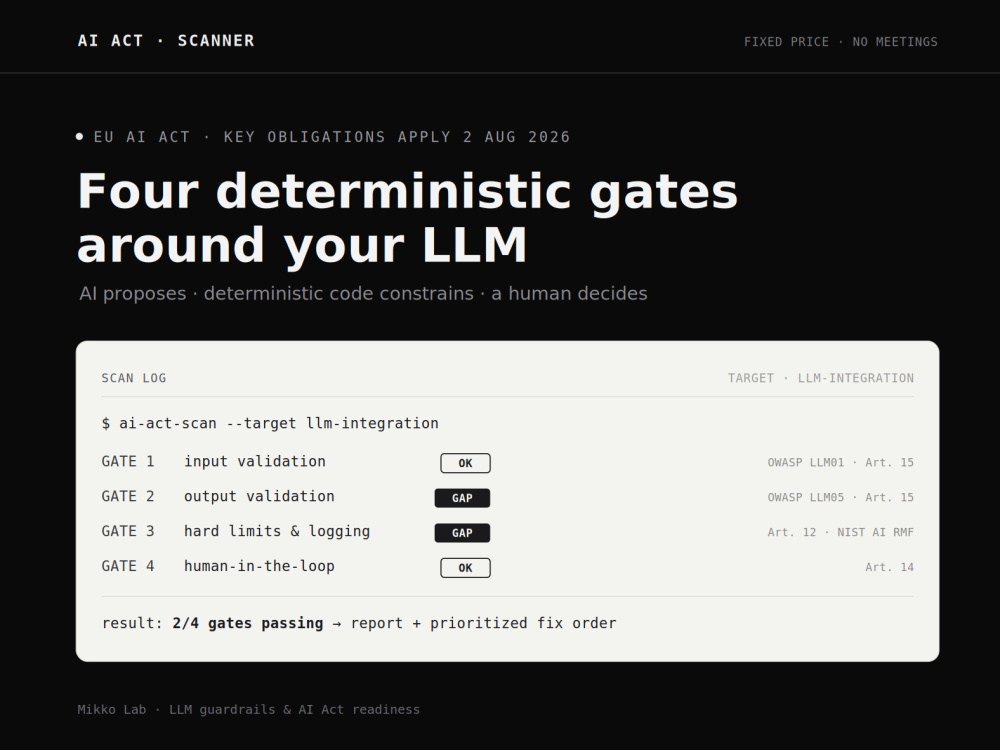
You will get a 48-hour technical readiness scan for your LLM integration against the EU AI Act, which becomes fully applicable August 2, 2026. I check your system against four deterministic guardrail gates — input validation, output validation, logging/hard limits, and human-in-the-loop approval for irreversible actions — and map every gap to the specific AI Act articles (12, 14, 15) and OWASP LLM Top 10 risks it falls under. My background is WCAG and EN 301 549 compliance auditing, so this is the same discipline — systematic, evidence-based, checklist-driven — applied to a newer regulation. You get a fixed price, a clear fix-priority order, and concrete implementation steps for your developer. No meetings, no lawyer-speak.
AI Algorithms
Large Language Model, Multimodal Large Language Model, Transformer ModelAI Applications
Anomaly Detection, Conversational AI, Natural Language Generation, Natural Language UnderstandingAI Development Language
PythonAI Tools
Azure OpenAI, Hugging FaceAI Models
ChatGPT, GPT-4What's included $150
These options are included with the project scope.
$150
- Delivery Time 2 days
- Number of Revisions 1
- AI Model Integration
- Model Documentation
- Model Monitoring
- Model Testing & Optimization
Optional add-ons
You can add these on the next page.
Fast 1 Day Delivery
+$50Frequently asked questions
About Mikko
AI Engineer | LLM Agents, Guardrails & Production Reliability
Vantaa, Finland - 3:32 pm local time
I ran a fully digital business for 21 years before retraining as an engineer, so I build systems that ship and behave, not demos.
Most LLM projects break in the same place: the model works in the demo, then does something unbounded, untraceable, or unsafe the moment real users and real money show up.
My work is the layer that prevents that — bounded actions, rate and budget limits, hash-chained audit logs, approval gates, and falsifiable evals that tell you when the system is actually wrong.
Where I help:
▸ Guardrail & control layers around LLM agents (LangGraph, Claude, OpenAI) — amplitude/budget bounds, deterministic rules, human approval steps
▸ Evaluation harnesses that define failure before you ship, not after
▸ Production AI features: backend architecture, API integrations, automation (TypeScript, Python, Node.js)
▸ Audit & traceability for regulated or high-stakes use cases (append-only logs, EU AI Act readiness)
I also treat accessibility (WCAG 2.2 AA) as a system-level engineering constraint — implemented in code, never overlays — when a project needs it.
If you have an AI feature that needs to be reliable, controllable, and defensible rather than just impressive, that's exactly the work I do. Send me the problem and I'll tell you straight whether I'm the right fit.
SELECTED PRODUCTION SYSTEMS
▸ Deterministic guardrail gate for LLM agents on financially critical paths — PASS/ESCALATE/BLOCK decision logic, verified with a 1,000-run determinism check and prompt-injection regression tests
▸ Same gate wired into Claude Code's own runtime (skill, subagent, MCP server, PreToolUse hook) — live testing caught two real bugs, including a case where the deterministic hook overrode a hallucinated subagent output
▸ Investigative-AI assistant with a hash-chained, tamper-evident audit log and a LangGraph checkpoint marking where human approval belongs in the workflow
▸ LLM document-intelligence & financial risk system — Claude-based analysis with structured, verifiable output
▸ Production mobile app orchestrating seven public APIs into a real-time hazard map for Finnish boaters
▸ AI accessibility auditing pipeline (WCAG 2.2 AA) — automated DOM-level analysis and reporting, validated with NVDA/VoiceOver
LLM systems & agents: LangGraph · Claude · OpenAI · eval harnesses · guardrails
Backend & automation: TypeScript · Python · Node.js · API integrations · Redis · OAuth 2.0
Reliability & compliance: audit logging · human-in-the-loop · WCAG 2.2 AA · EU AI Act
Steps for completing your project
After purchasing the project, send requirements so Mikko can start the project.
Delivery time starts when Mikko receives requirements from you.
Mikko works on your project following the steps below.
Revisions may occur after the delivery date.
Scan & gap analysis
I review your answers, run the four-gate analysis against your model, use case, and triggerable actions, and map every gap to the relevant AI Act article.
You receive the report (48h)
You receive a PDF report within 48 hours: a prioritized gap list and concrete implementation steps your developer can act on directly.