You will get AI Agent Cost Audit: Find Where You're Overspending on Claude/GPT/LLM API
Project details
Most teams running Claude, GPT, or LLM agents are overpaying 40-70% on routine tasks. Premium models doing work that mid-tier models could handle just as well. The trick isn't avoiding premium models, it's knowing which calls actually need them.
I'll review your workflow, find where the spending leaks, and give you a tier-routing strategy that cuts costs without sacrificing quality.
You get a 30-minute call walking through your setup, plus a written audit (1-2 pages) covering where you're overspending, which calls should route to cheaper models, which should stay on premium, and concrete recommendations with expected savings. Includes 1 round of follow-up.
Best fit: teams running LLM agents in production with uncomfortable monthly bills.
Not a fit: pre-production projects, or setups under ~$50/month.
Why me: I build multi-agent systems on Claude and OpenClaw with cost-optimized model tier routing across local and cloud. Recently cut my own nightly cron costs from ~$0.27 to $0.03-0.05 by routing calls correctly. Most production setups are overspending more than they realize.
I'll review your workflow, find where the spending leaks, and give you a tier-routing strategy that cuts costs without sacrificing quality.
You get a 30-minute call walking through your setup, plus a written audit (1-2 pages) covering where you're overspending, which calls should route to cheaper models, which should stay on premium, and concrete recommendations with expected savings. Includes 1 round of follow-up.
Best fit: teams running LLM agents in production with uncomfortable monthly bills.
Not a fit: pre-production projects, or setups under ~$50/month.
Why me: I build multi-agent systems on Claude and OpenClaw with cost-optimized model tier routing across local and cloud. Recently cut my own nightly cron costs from ~$0.27 to $0.03-0.05 by routing calls correctly. Most production setups are overspending more than they realize.
AI Algorithms
Large Language Model, Transformer ModelAI Applications
AI Chatbot, AI-Generated Code, Conversational AI, Natural Language UnderstandingAI Tools
Azure OpenAIAI Models
ChatGPT, GPT-4, OpenAI Codex, WhisperWhat's included $100
These options are included with the project scope.
$100
- Delivery Time 3 days
- Number of Revisions 1
- Model Documentation
- Model Testing & Optimization
About Marco
OpenClaw specialist. I build, evaluate, and fix AI agent systems
Central, Hong Kong - 5:29 am local time
A lot of agent work right now is built for the demo: flashy on the surface, fragile underneath. I build the version that holds up. That means real attention to memory, skills, handoff logic, and matching the platform and model to the actual job, the parts that decide whether your system still works at week six, not just week one.
What I can help with:
Designing workflows and automations for the parts of your business that eat time: appointment setting, lead qualification, customer service, content pipelines, internal ops. The goal is something that runs reliably without you babysitting it.
Picking the right platform for the job: OpenClaw, Claude Code, Cowork, Hermes, custom. Most projects don't need the fanciest option; some really do. I can tell you which is which before you commit to a stack you'll regret.
Choosing the right model for each role: Claude, GPT, open-source, local. The biggest model isn't always the right one; the cheapest model usually isn't either. Matching the model to the actual task is most of the cost-and-quality tradeoff.
Architecting agent systems that don't fall apart: agent routing, file and configuration structure, how the pieces fit together. This is the layer that determines whether your agent stays coherent at week six or starts making things up.
Building memory that actually works: what to remember, what to forget, when to compress, how to handle stale info. Most agent failures I see are memory failures dressed up as something else.
Designing handoff and escalation logic: when one agent passes to another, when it escalates to a human, and how to make the triggers reliable. The boring part of agent design that decides whether the system is trustworthy.
Turning prototypes into production: adding integrations (Calendly, CRM, webhooks), wiring error handling, getting it stable enough to run unattended. Prototypes break in interesting ways; production needs to break in predictable ones.
Reviewing or pressure-testing what you've already built: finding what's broken, what's fragile, and what's wasted. Often the highest-leverage thing you can pay for, because rebuilding the wrong thing is more expensive than fixing the right one.
I'm probably not the best fit if you want someone who'll just nod and execute. I'll flag when I think part of your plan won't work, suggest a different approach if there's a better one, or push back on scope when it doesn't make sense. That's usually where I add value beyond doing the work itself.
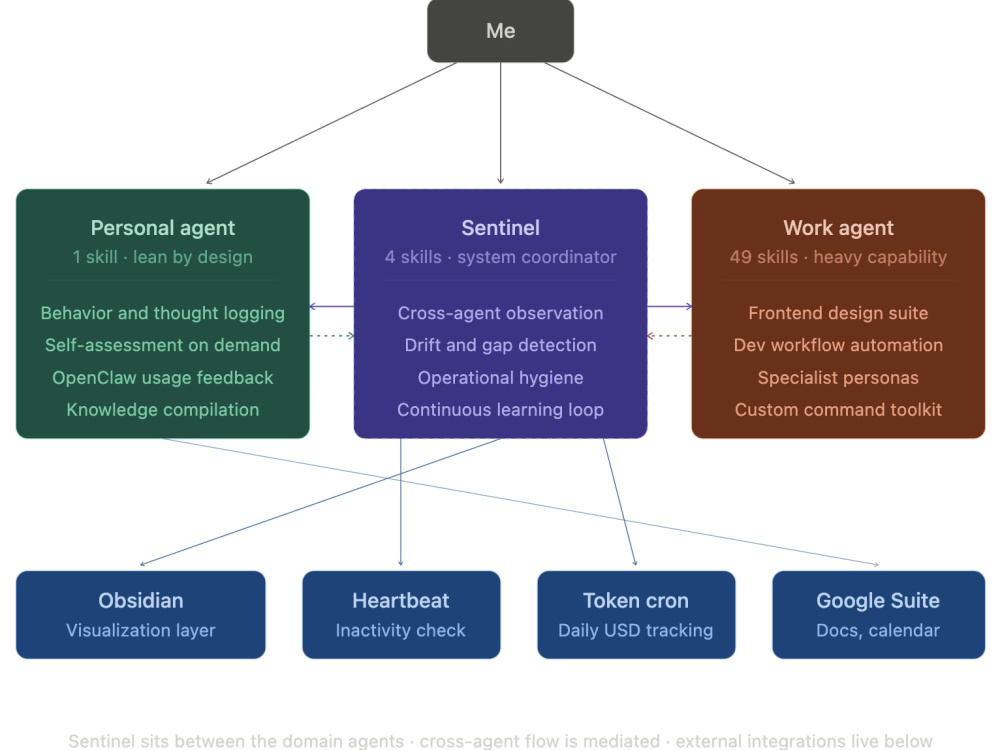
Recent project: a three-agent personal ecosystem. One agent for personal life, one for work, and a monitoring agent that sits above both, watching for drift, gaps, and inconsistencies before they compound. OpenClaw rewards good architecture. The system gets more leveraged the more it has to work with, so the structural decisions early on matter more than the number of agents. A smarter single agent isn't the answer for managing mixed contexts; a structured division of labor with a layer that catches what individual agents can't see about themselves is.
Send a message if you want to talk through what you're building. I respond fast, ask real questions, and won't pitch you something that doesn't fit.
Steps for completing your project
After purchasing the project, send requirements so Marco can start the project.
Delivery time starts when Marco receives requirements from you.
Marco works on your project following the steps below.
Revisions may occur after the delivery date.
Review your setup and prepare initial findings
I review your workflow description, spend, and example tasks. Identify likely cost-optimization opportunities before our call so we can use the time efficiently.
30-minute audit call
We walk through your setup live. I ask targeted questions, surface assumptions, and confirm where the highest-leverage cost savings are. You get clarity on what's worth changing and what isn't.