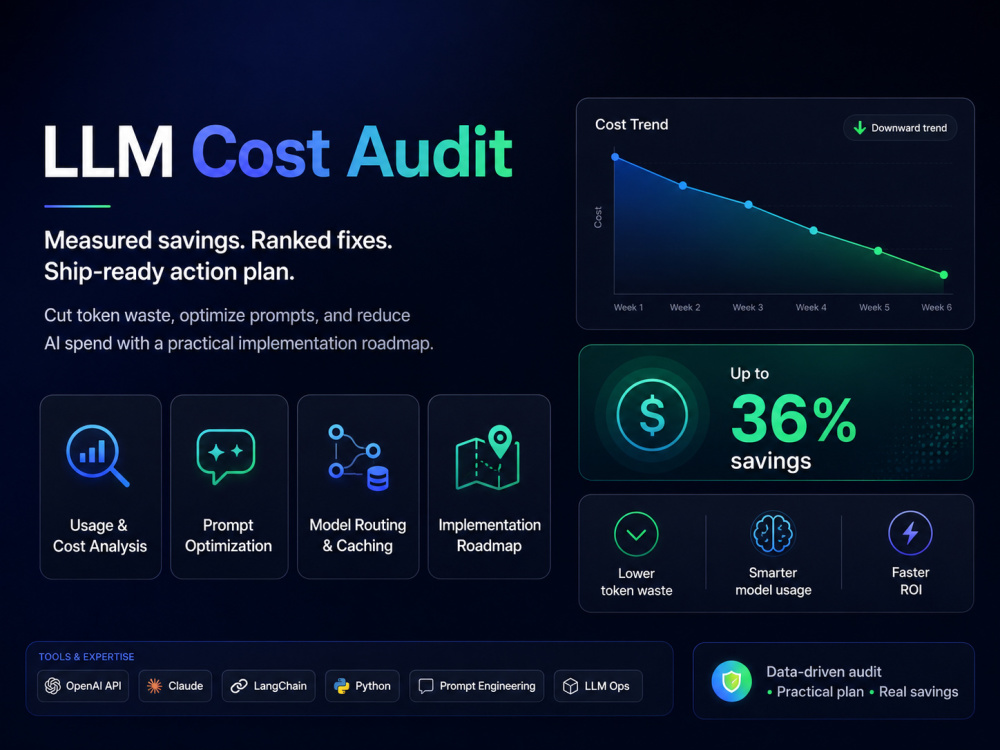
You will get an LLM cost audit with measured savings and a ranked fix plan you can ship
Project details
You're paying for tokens you don't need. Calling Sonnet when Haiku would do, retrieving 20 chunks when 5 is enough, retrying on every parse error, sending the same system prompt unchanged when prompt caching would cut it 80%.
I dig in. In seven days I instrument every LLM call site in your codebase, run a representative day of your traffic through the instrumentation, and produce a ranked fix plan with measured dollar savings per fix.
The report shows: spend by endpoint, spend by model, the top 5 cost levers ranked by measured impact, and the exact code changes for each. No generic advice. Specific lines, specific files, specific savings.
Typical first-pass result on a $5-20k/mo Anthropic or OpenAI bill is a 30-50% cut without changing user-facing behavior. I've shipped per-call cost accounting in production at Decathlon and built the open-source eval-kit on the same instrumentation pattern.
You give me access on day 1. I deliver on day 7. If the audit doesn't surface at least three fixes with measured savings worth more than this engagement, I refund the difference.
I dig in. In seven days I instrument every LLM call site in your codebase, run a representative day of your traffic through the instrumentation, and produce a ranked fix plan with measured dollar savings per fix.
The report shows: spend by endpoint, spend by model, the top 5 cost levers ranked by measured impact, and the exact code changes for each. No generic advice. Specific lines, specific files, specific savings.
Typical first-pass result on a $5-20k/mo Anthropic or OpenAI bill is a 30-50% cut without changing user-facing behavior. I've shipped per-call cost accounting in production at Decathlon and built the open-source eval-kit on the same instrumentation pattern.
You give me access on day 1. I deliver on day 7. If the audit doesn't surface at least three fixes with measured savings worth more than this engagement, I refund the difference.
AI Algorithms
Deep Belief Network, Generative Adversarial Network, Large Language Model, Long Short-Term Memory Network, Transformer ModelAI Applications
AI Chatbot, AI Text-to-Image, AI Text-to-Speech, AI-Enhanced Classification, AI-Generated Art, AI-Generated Code, AI-Generated Music, AI-Generated Video, AIOps, Conversational AI, Natural Language Generation, Natural Language UnderstandingAI Development Language
PythonAI Tools
Azure OpenAI, GitHub Copilot, Gradio, Hugging Face, NVIDIA AI Platform, PyTorch, Replit, Streamlit, TensorFlow, Word2vecAI Models
AlphaCode, BERT, ChatGPT, DALL-E, GPT-3, GPT-4, Jurassic-2, LaMDA, LLaMA, Naive Bayes Classifier, OpenAI Codex, WhisperWhat's included
| Service Tiers |
Starter
$650
|
Standard
$1,500
|
Advanced
$2,800
|
|---|---|---|---|
| Delivery Time | 3 days | 7 days | 12 days |
Number of Revisions | 1 | 2 | 3 |
AI Model Integration | - | - | |
Batch Normalization | - | - | - |
Database Integration | - | - | |
Detailed Code Comments | |||
Image Upscaling | - | - | - |
MLOps | - | ||
Model Deployment | - | - | |
Model Documentation | |||
Model Monitoring | - | ||
Model Testing & Optimization | |||
Model Tuning | - | - | |
Natural Language Processing | |||
NLP Tokenization | - | - | - |
Pre-Training | - | - | - |
Prompt Engineering | |||
Setup File | - | - | |
Source Code | - |
Optional add-ons
You can add these on the next page.
Cost dashboard wired into your monitoring stack
(+ 2 Days)
+$400
60-day re-audit on current traffic
(+ 2 Days)
+$300Frequently asked questions
About Amir
Senior AI/LLM Engineer | RAG, AI Agents, LangChain, LLM Evals
Paris, France - 12:28 am local time
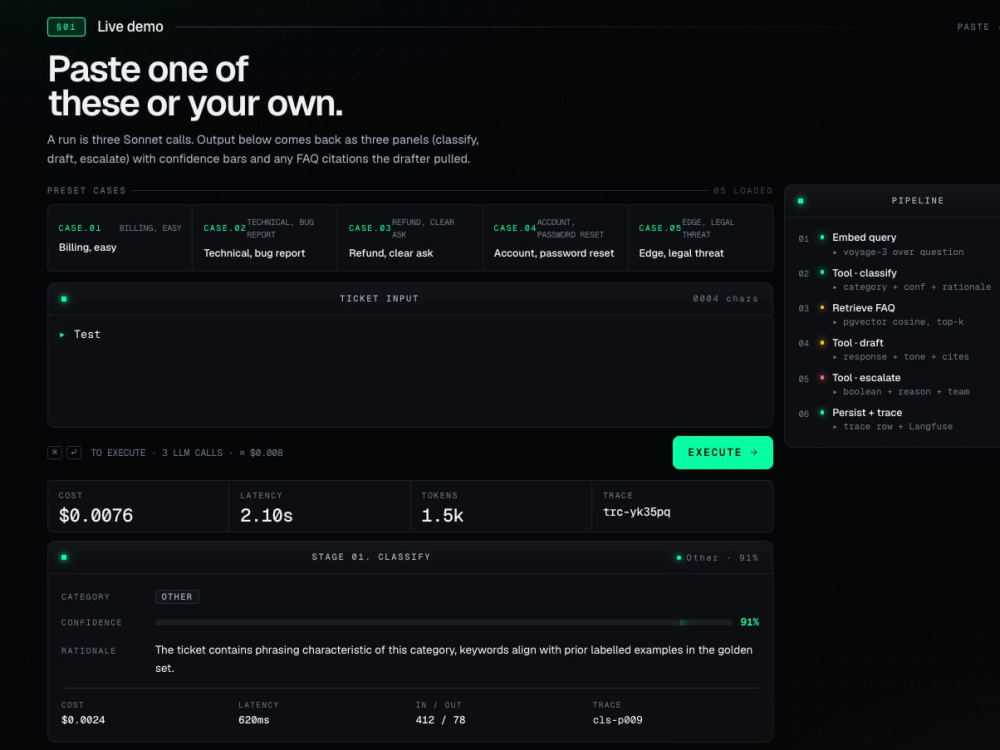
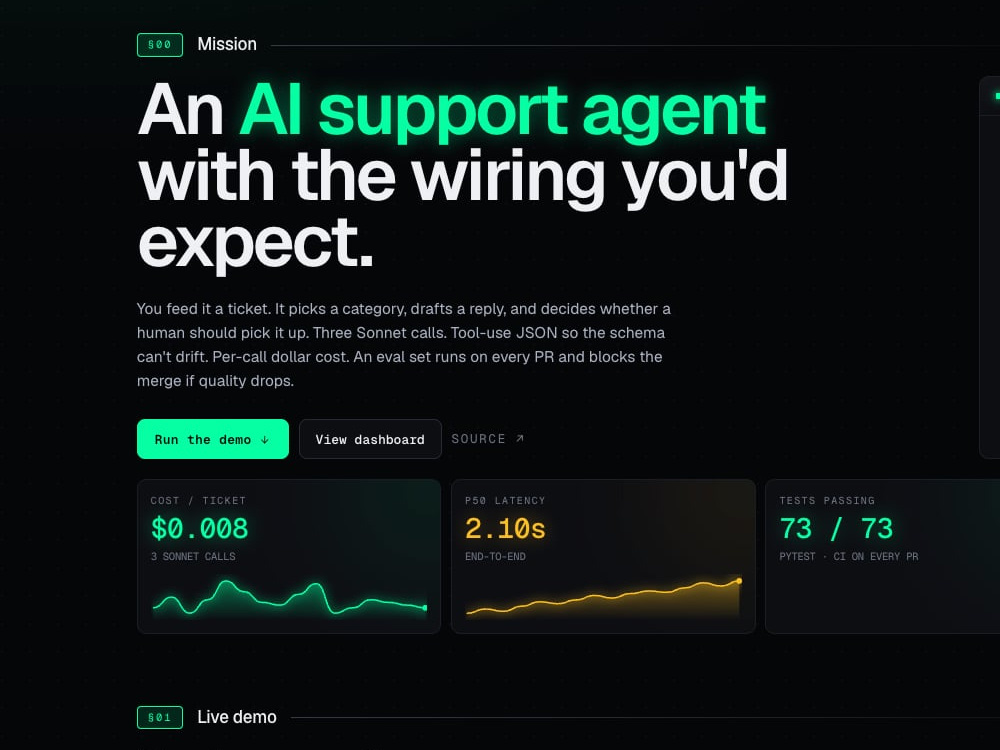
Currently at Decathlon building a Claude support agent with RAG over the product catalogue: three Sonnet calls (classify, draft, escalate) through Anthropic's tool-use API, per-call cost accounting, a 50-row eval set running in CI. Before that, three years at Allianz taking the insurer's first LLM applications from prototype to production: a document Q&A system for claim adjusters, a multi-step research agent on LangGraph, and a vendor-neutral wrapper around Anthropic and OpenAI. Three years before that at Société Générale on classical ML and NLP: a transformer-based document classifier for compliance, OCR for scanned regulatory filings, the team's first embeddings-based search.
What I publish on GitHub:
- A production RAG reference that refuses to answer when retrieval does not support the claim. 50-question eval gate blocks merges on more than 3 points of regression.
- A customer-support agent: three Sonnet calls, calibrated confidence, real cost accounting, eval gate in CI.
- A 7-node LangGraph DAG with a parallel fan-out and a critic retry loop. Streams per-node telemetry over SSE.
- An open-source Python library for LLM evals: calibrated LLM-as-judge, synthetic adversarial data, regression diff that fails the PR.
Stack: Python, FastAPI, Anthropic Claude, OpenAI, LangGraph, Voyage embeddings, pgvector, Postgres, Modal, Langfuse, Next.js, Tailwind. Bar: mypy strict, ruff, pytest with a coverage gate, golden-set evals in CI, structlog, per-call cost tracking. Every repo runs make ci clean from a fresh clone.
Best fit for:
- Building a RAG system that has to cite, not invent.
- Taking a multi-step agent prototype to production.
- Setting up the eval and quality engineering layer your team has been meaning to build.
EU timezone, 30+ hours per week, async-friendly.
Steps for completing your project
After purchasing the project, send requirements so Amir can start the project.
Delivery time starts when Amir receives requirements from you.
Amir works on your project following the steps below.
Revisions may occur after the delivery date.
Day 1: setup and access
Receive your repo, last 30 days of spend by provider, traffic sample, and savings target. Local dev environment up. Baseline reproduction confirmed before any instrumentation work begins.
Days 1-2: instrument every LLM call site
Add per-call cost accounting at every LLM call site: model used, input tokens, output tokens, retries, cache hits. Plus runtime tags for endpoint, user segment, and feature flag if relevant.