You will get Set up observability for your AI agents and LLM workflows
Project details
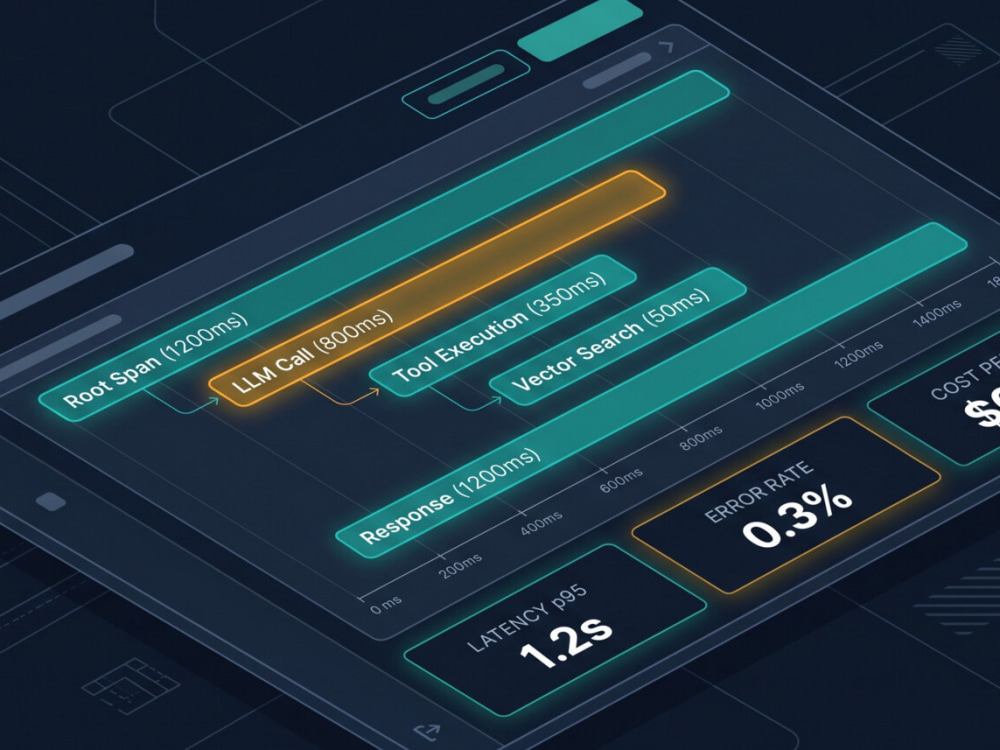
AI systems are weirdly hard to debug. A workflow fails and all you have is "the agent didn't return what I expected." A run is slow and nobody can tell if the bottleneck is the model, the tool, or the retrieval. Cost is climbing but no one knows which call is driving it. Most teams don't have any real observability until something is already on fire. I set up the layer that fixes that — OpenTelemetry-based tracing, structured logs with the right metadata, dashboards for latency and failure and spend, and a debugging playbook your team can actually use at 2 AM. Output: given an angry Slack message about a failed run, how fast can one of your engineers understand what happened?
AI Algorithms
Large Language ModelAI Applications
AI Chatbot, Conversational AIAI Development Language
PythonAI Models
ChatGPT, GPT-4, OpenAI CodexWhat's included
| Service Tiers |
Starter
$1,500
|
Standard
$3,500
|
Advanced
$5,500
|
|---|---|---|---|
| Delivery Time | 5 days | 10 days | 12 days |
Number of Revisions | 1 | 2 | 2 |
AI Model Integration | - | - | - |
Batch Normalization | - | - | - |
Database Integration | - | - | - |
Detailed Code Comments | - | - | - |
Image Upscaling | - | - | - |
MLOps | - | ||
Model Deployment | - | - | - |
Model Documentation | |||
Model Monitoring | |||
Model Testing & Optimization | - | - | - |
Model Tuning | - | - | - |
Natural Language Processing | - | - | - |
NLP Tokenization | - | - | - |
Pre-Training | - | - | - |
Prompt Engineering | - | - | - |
Setup File | - | - | - |
Source Code | - | - | - |
About Thierry
Senior AI Systems Engineer | Agent Runtime, Orchestration, Reliability
Sao Paulo, Brazil - 2:47 am local time
For the past two years I've been an engineer at a venture-backed AI startup, building the layer underneath production AI workflows. A DAG-based workflow engine with pluggable actions: LLMs, agents, document processing, code execution, integrations. Nested sub-workflows and fan-out. Step-by-step debugging. Workflow build time went from about two weeks to 1–3 days, which finally let non-engineers ship to production.
The work I kept getting pulled into was the operationally painful stuff. A sandboxed environment for running untrusted code during agent tool-use — cold starts, timeouts, retries, automated image builds. A serverless PDF parser handling several hundred thousand pages a month, shipped with both Python and TypeScript SDKs. A document parsing proxy routing millions of pages a year across providers, with SLAs and failover built in. OpenTelemetry tracing and structured logs tuned so both humans and coding agents — Claude Code, Codex — can debug production incidents without escalation.
What I'm selling isn't the stack. It's the judgment I built doing that work, applied to your system.
How I usually help:
— architecture review on something you haven't shipped yet and you're unsure about
— production readiness audit on a system that's already live and fragile
— a focused 6–8 week sprint to build one piece right: sandbox, runtime, or observability layer
— part-time retainer as the senior AI infra voice on your team, around 10 hrs/week
I'm not the right person for a ChatGPT wrapper build or generic n8n/Zapier plumbing. If you don't need me, I'll say so — I'd rather lose the sale than bill you for work you can do cheaper elsewhere.
Stack I ship with: TypeScript, Node.js, Python, AWS serverless (SST + Pulumi), OpenTelemetry, E2B, distributed systems.
Availability: 10–20 hrs/week for a small number of clients at a time. We usually start with a short diagnostic call to figure out if I'm actually useful to you.
Steps for completing your project
After purchasing the project, send requirements so Thierry can start the project.
Delivery time starts when Thierry receives requirements from you.
Thierry works on your project following the steps below.
Revisions may occur after the delivery date.
Review current setup
You share your stack, where logs and metrics live, architecture, and example incidents. I review the current state.
Instrument and build
I set up OpenTelemetry tracing, structured logging with the right metadata, and dashboards for latency, failure, and cost.